John Wilson is the owner of Dawsonville Lawn Pros and a U.S. Navy veteran. He graduated magna cum laude from Texas A&M University and holds a master’s degree from Columbia Southern University. Before founding Dawsonville Lawn Pros in 2015, he built his professional foundation in industrial safety management. This background shaped the disciplined, detail-oriented approach he brings to every property he serves.
Quick Answer
White Oak is one of the latest-dropping deciduous trees in North Georgia, often not completing its drop until late December or January on Dawsonville’s wooded properties. A single fall cleanup in October or November clears the early-dropping species but misses the biggest part of the White Oak leaf load. On properties with significant White Oak or Hickory canopy, a two-visit approach — an initial cleanup in November and a follow-up in December or January — is the only strategy that actually protects your Bermuda or Zoysia lawn through winter.
Fall leaf drop in North Georgia is not a single event that happens in October and ends in November. It’s a rolling process that unfolds over three to four months, driven by the mix of tree species on your property and the elevation, aspect, and microclimate of your specific lot. In Dawsonville and across Dawson County’s wooded terrain, that process extends significantly later than most homeowners expect — and significantly later than generic fall cleanup guides written for Metro Atlanta or South Georgia would suggest.
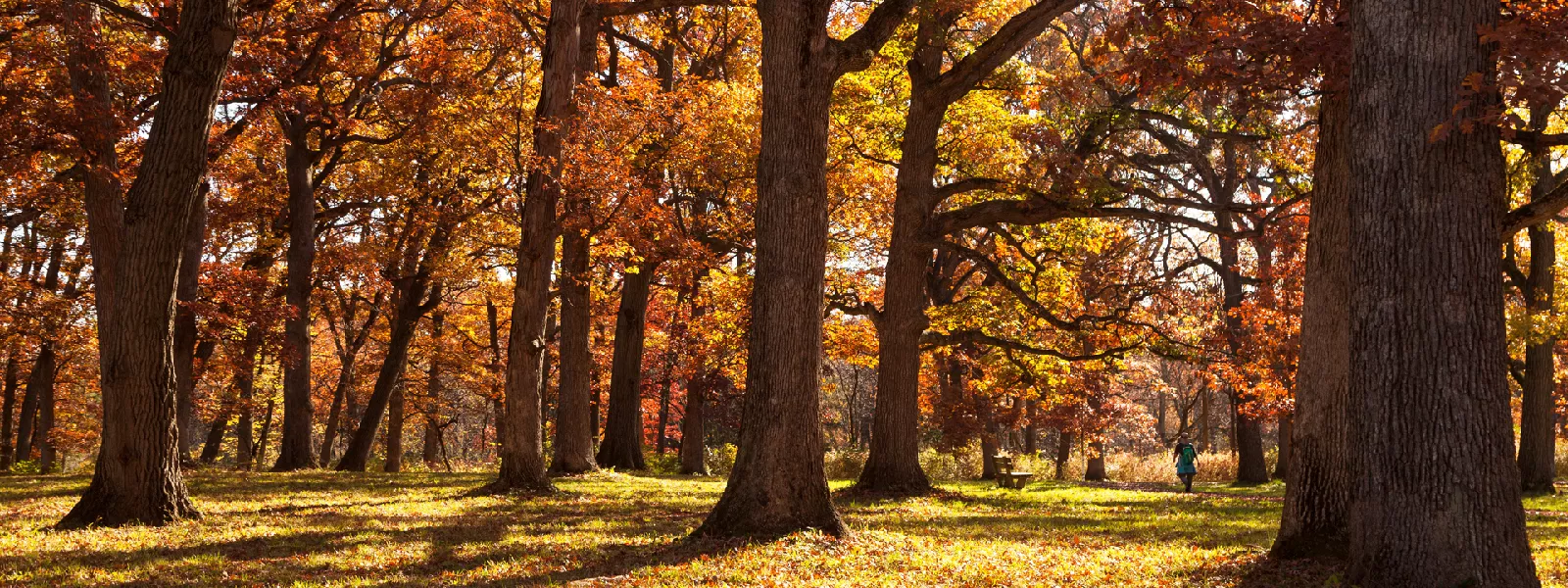
The reason comes down to tree species. The early droppers — Yellow Poplar, Sassafras, Dogwood, Red Maple — shed their leaves in October and are done by early November. These are the trees that put on the early fall color display, and their leaves are off the canopy before most homeowners have even scheduled a cleanup. The late droppers — White Oak, Chestnut Oak, Hickory, and American Beech — are a different story. These species don’t even reach peak color at Dawsonville’s elevation until early to mid-November, and they frequently don’t complete their drop until December. On Dawsonville’s most heavily wooded properties, White Oak leaves are still coming down in January.
That timing gap — six to ten weeks between the early and late droppers — is what makes a single October cleanup insufficient for most Dawson County wooded properties. The October cleanup clears what the Maples and Poplars dropped. The White Oaks haven’t started yet. For a full picture of how Dawsonville’s Zone 7b microclimate affects lawn care timing across all turf types, our Complete Guide to Lawn Care in North Georgia covers the seasonal calendar in depth.
Pro Tip
The Georgia Forestry Commission’s annual Leaf Watch reports confirm this timing pattern. In both 2024 and 2025, the commission’s field observers noted that White Oak and Chestnut Oak in the Dawsonville, Gainesville, and Cumming elevation range were just reaching peak color in the first week of November — weeks after early-dropping species had already shed. Areas around Dawsonville were specifically noted as offering prime fall color viewing in early to mid-November, with oak species in transition to peak at that point. Drop completion for White Oak in these elevations consistently extends into December.
Understanding which trees are on your property — and the typical drop timeline for each — is the starting point for planning a realistic fall cleanup schedule. The table below shows the most common hardwood species on Dawson County residential properties and their typical leaf drop windows at Dawsonville’s elevation.
White Oak (Quercus alba) is the defining tree on a significant portion of older, larger Dawsonville residential lots — particularly in established neighborhoods like Chestatee Bend, Gold Creek, and along the county’s creek corridors where mature hardwoods have been growing for decades. It’s one of North Georgia’s most majestic native trees and one of the most challenging for lawn management.
The challenge is timing. White Oak is among the latest-dropping deciduous trees in the eastern United States. Unlike Red Maple or Yellow Poplar, which shed their leaves quickly once the color peaks, White Oak drops slowly and unevenly — individual trees on the same property may start dropping at different times, and the drop can extend over six to eight weeks from first leaf to final leaf. On Dawsonville’s most heavily wooded properties, White Oak leaves are still actively falling in January.
What makes White Oak particularly difficult is the leaf volume. A large, mature White Oak can drop several hundred pounds of leaves across a single season. On a property with multiple mature White Oaks, the cumulative leaf load from December and January alone — after the rest of the canopy is bare — can equal or exceed the entire early-season leaf load from all the early-dropping species combined.
Hickory is White Oak’s companion species on most Dawsonville wooded lots, and it presents a similar timing challenge. However, it typically completes its drop in late November rather than extending into January. Hickory leaves are large, compound (multiple leaflets on a single stem), and pack down densely when wet. A thick mat of Hickory leaves in late November can smother a dormant Bermuda lawn as effectively as a White Oak mat, with the added difficulty that the compound leaves interlock when wet and are significantly harder to blow or rake than single-lobed leaves.
American Beech is notable for a phenomenon called marcescence — the retention of dead, dried leaves on the branches through winter. On Dawsonville properties where Beech is present, the papery brown leaves that remain attached through February and March are not a cleanup target — they stay on the tree until the new spring growth pushes them off. The leaves that do fall from the Beech typically drop in late fall and are manageable. The ones that stay on the tree are not a lawn issue, and there’s no benefit to trying to remove them.
This is where fall leaf management stops being a cosmetic issue and becomes a lawn health issue. A thick, wet mat of leaves sitting on dormant Bermuda or Zoysia through winter is not harmless. It creates three specific problems that show up in spring — sometimes weeks after the leaves are finally cleared.
Wet leaves held against dormant turf create the warm, moist conditions that fungal pathogens need to establish. Large Patch (Rhizoctonia solani) and Brown Patch are the primary culprits in North Georgia Bermuda and Zoysia lawns. These fungi don’t need warm air temperatures to establish — they need moisture and organic material in contact with the turf crown, exactly the conditions a wet leaf mat provides through Dawson County’s wet fall and winter.
The damage from fungal disease established under a winter leaf mat doesn’t become visible until spring green-up. In April, when the Bermuda or Zoysia lawn begins waking up and greening, affected areas show as irregular brown or tan patches — sometimes several feet in diameter — that lag behind the surrounding turf in green-up or fail to green up entirely. By the time the damage is visible, it’s too late to prevent it. Prevention requires keeping the leaf mat off the dormant turf before the fungal conditions can establish.
Dormant Bermuda and Zoysia are not completely inactive. The crown and root system continue slow biological processes through winter that support the stored energy reserves the grass will use for spring green-up. A dense leaf mat that blocks virtually all light from the turf surface for three to four months weakens these processes and depletes the energy reserves the grass needs for vigorous green-up in spring.
The practical result is visible in April: lawns with leaf mats on them through winter consistently show slower, thinner, and more uneven spring green-up compared to lawns that were kept clear. The difference isn’t subtle on properties where significant leaf accumulation went unmanaged — the lawn may look patchy and thin well into May, while sections that had clean turf through winter are dense and uniform. Getting the lawn back on track after a winter of leaf mat damage typically starts with a corrected mowing schedule — see our lawn mowing service for Dawsonville HOA properties.
Leaves don’t just pile on the lawn. They blow into beds, pack down between plants, and create a wet, compacted layer over the soil surface that can smother low-growing plants and interfere with mulch doing its job. Foundation plantings — Loropetalum, Nandina, Indian Hawthorn, and other low-growing shrubs — can show stress from winter leaf accumulation packed around their crowns. A thorough fall cleanup that clears beds as well as the lawn addresses this problem before it causes visible plant damage.
Pro Tip
The visible spring damage from a winter leaf mat — the irregular brown patches that don’t green up normally — is frequently misdiagnosed as a disease that needs chemical treatment. In many cases it IS disease, but the source is the leaf mat from the previous fall, not something that happened in spring. If you’re seeing irregular patches every April, ask yourself whether those areas had heavy leaf accumulation over winter. The answer is often yes, and clearing the leaf mat the following fall prevents the spring problem entirely.
A single fall cleanup in October or November is appropriate for properties with minimal tree canopy or only early-dropping species — Maples, Poplars, Dogwoods. For Dawsonville’s wooded properties with White Oak and Hickory in the canopy, a single visit is insufficient for structural assessment. It clears the first wave and leaves the largest wave still pending. Our Dawsonville leaf cleanup program is built around the two-visit model for properties with White Oak and Hickory canopy.
The two-visit approach is the practical answer, and it’s how we schedule fall cleanup for Dawsonville’s heavily wooded residential properties.
The first cleanup visit falls in November — typically the second or third week of November in most years at Dawsonville’s elevation. The goal of this visit is to clear the early and mid-season droppers: Yellow Poplar, Red Maple, Sassafras, Dogwood, Sweetgum, and the portion of Hickory that has dropped by that point. This visit also addresses the dormant Bermuda or Zoysia lawn, clearing it before the leaf mat has had weeks to compact and create fungal conditions.
At this point, the White Oaks are typically in their color peak or just beginning to drop in earnest. Trying to do a definitive final cleanup in November on a White Oak property doesn’t make sense — you’ll be back in the same spot within two to three weeks as the Oaks finish their drop. The November visit handles everything that has dropped and sets the lawn up clean going into December.
The second cleanup visit targets what the White Oaks and any remaining Hickory dropped after the November visit. In most years at Dawsonville’s elevation, this visit falls between mid-December and mid-January. By this point, the White Oaks on most properties are completely bare or within a week of bare, and the second cleanup can realistically be a final cleanup for the season.
The second visit is particularly important for Bermuda and Zoysia lawns. By late December, the lawn has been dormant for six to eight weeks. White Oak leaves that fell after the November visit have been sitting on the dormant turf long enough to start compacting and creating the moisture conditions that support fungal establishment. Clearing them by mid-January gives the turf three to four months of clear, clean conditions before spring green-up begins in late March or early April.
Pro Tip
The timing of the second visit can be flexible around the trees themselves. If your White Oaks are still actively dropping in late December, waiting until early January to do the second visit is more efficient than doing it in December and finding the lawn covered again by January. Watch the canopy — when the Oaks are 80 to 90 percent bare, the second visit will hold.
Not every Dawsonville property needs a two-visit program. The two-visit approach is warranted for properties with:
Properties that are appropriate for a single cleanup visit include:
Pro Tip
If you come back from vacation or miss a week and the lawn has gotten significantly ahead, do not try to get back to target height in a single mow. Take it down one-third this week, then back down toward the target next week, and full target height the week after. Three passes spread over 10 to 14 days get the lawn back to target without the scalping damage that a single hard cut would cause.
The first step in planning the right fall cleanup schedule for your Dawsonville property is knowing what trees you have. This doesn’t require a professional arborist assessment for most homeowners — the combination of leaf shape, bark character, and fall color timing is enough to identify the species that matter most for cleanup planning.
White Oak has distinctive lobed leaves with rounded (not pointed) tips — the key visual difference from Red Oak, which has pointed lobes. The bark is light gray and distinctly blocky or plated in appearance on mature trees. In fall, White Oak turns shades of brownish gold, orange, and dull red — not the vivid scarlet of Red Maple or the bright yellow of Hickory. If you have large trees on your property with rounded-lobed leaves that are still holding onto brownish leaves well into December, those are White Oaks.
Hickory leaves are compound — multiple leaflets arranged along a central stem, giving each leaf a feather-like appearance with five to nine leaflets per stem. Hickory turns bright, clean yellow in fall — one of the most vivid yellows in North Georgia’s fall palette. The bark is shaggy and peeling on mature trees (Shagbark Hickory) or tightly ridged (Pignut Hickory), both of which are common in Dawson County. If you have trees with compound leaves turning bright yellow in November, those are Hickories.
The practical approach: in October, watch which trees are dropping leaves first and which are holding onto green leaves while everything else around them is turning. The trees that are still largely green in early November while Maples and Poplars are bare are your late droppers — almost certainly White Oak or Hickory at Dawsonville’s elevation. Those are the trees that determine whether you need a two-visit cleanup program.
The Georgia Forestry Commission issues weekly Leaf Watch reports throughout fall, with field observers documenting color change and leaf drop across North Georgia’s elevation ranges. These reports provide objective confirmation of what we observe on Dawsonville properties every fall season.
In both 2024 and 2025, the commission’s reports showed White Oak and Chestnut Oak in the Dawsonville, Gainesville, and Cumming elevation range reaching peak color in the first week of November — after Yellow Poplar and Maple had already shed. The 2025 report specifically noted that as of early November, ‘many red oak and white oak species are nearing peak, along with hickories’ in the Dawsonville area — confirming that these species were still holding leaves at that point, not completing their drop.
The 2024 and 2025 reports also confirmed that Dawsonville and surrounding areas represent some of the best fall viewing in North Georgia in early-to-mid November — precisely because the White Oaks and Hickories are still in peak color at that point. For lawn management purposes, this means the trees that look most beautiful in early November are the ones that will be dropping their leaves through December.
The combination of biweekly mowing and a target height below 1.5 inches during peak season is a guaranteed recipe for scalping. A lawn cut to 1.5 inches and left for two weeks in June will be at 3 inches or more — cutting it back to 1.5 inches removes half the blade in a single pass. The resulting brown, stressed appearance is the most common Bermuda complaint we hear from homeowners who switched from weekly to biweekly service during summer to save money. The apparent savings disappear when the lawn requires remedial work.
Scalping before the frost risk has passed in Dawsonville exposes the turf crown to late-winter cold snaps. A late March freeze event after an early scalp mow can damage Bermuda crowns that had been protected by the thatch layer and are now exposed. The result is a slow, uneven spring green-up with patches that lag weeks behind the surrounding turf. In Dawsonville, confirm a sustained warming trend with no forecast overnight lows below 35°F before scalping.
Lawns mowed at summer height, going into dormancy in Dawsonville, have less crown protection through winter than lawns raised to 2 to 2.5 inches in September. This is particularly consequential for properties with cold-air drainage from surrounding terrain — low-lying areas of Dawson County’s hilly landscape that collect cold air on still nights can experience temperatures several degrees colder than those on the surrounding hillsides. The additional blade height provides meaningful insulation in these conditions.
Mowing Bermuda while wet — dew-covered in the early morning, or immediately after rain — produces poor results regardless of season. Wet grass doesn’t cut cleanly: mower blades tear rather than cut, leaving ragged, browning blade tips. Wet clippings clump rather than distribute evenly across the lawn, creating matted piles that block light and promote fungal conditions underneath. Always let the lawn dry for at least two hours after rain or morning dew before mowing.
Dull mower blades rip rather than cut grass blades. The ragged edges created by dull blades are more susceptible to fungal infection — the torn tissue is a direct entry point for pathogens — and the shredded blade tips produce the brown, frayed appearance that makes a freshly mowed lawn look worse than before it was cut. Sharpen rotary mower blades at least once per season, and more often if you’re mowing regularly on a half-acre lot. If you can visibly see a dull, bent, or chipped edge when you inspect the blade, sharpen it before the next mow.
A significant portion of Bermuda lawns in Dawsonville sit in HOA communities with defined appearance standards. Understanding what those standards practically require — and how a correct mowing schedule satisfies them — removes the stress of wondering whether your lawn meets requirements.
An October cleanup is only complete if your property has exclusively early-dropping species. For any Dawsonville property with White Oak or Hickory in the canopy, an October cleanup handles the first wave and leaves the most significant leaf load — the late droppers — still pending. The lawn looks clean in late October and is buried again by December. October cleanups are appropriate as a first visit in a two-visit program, not as a standalone solution on wooded properties.
The opposite mistake — waiting until every leaf is down before scheduling a cleanup — means the lawn has been under a wet, compacting leaf mat for weeks or months before it’s finally cleared. By the time a January cleanup happens on a property that went unmanaged since October, the fungal conditions are well established and the winter damage to the dormant turf is done. The first cleanup visit should happen before the full leaf load is down, not after.
Many homeowners schedule fall cleanup based on what a company offers as a standard service — typically a single visit in October or November. That standard is appropriate for some properties and insufficient for others. If your property has significant White Oak or Hickory canopy and your current provider offers only one fall cleanup visit, you either need to schedule a second visit separately or find a provider who understands the two-visit requirement for wooded Dawson County properties.
A cleanup that clears the lawn but leaves the beds packed with leaves has solved part of the problem. Leaves that compact into foundation beds and around plant crowns over winter create moisture conditions that stress evergreen shrubs and can damage low-growing ground cover. Our spring and fall cleanup service clears both lawn and beds — a cleanup that leaves the beds unaddressed is only a partial solution.
White Oak trees in Dawsonville and Dawson County typically complete their leaf drop between late December and mid-January, depending on the year's weather patterns. In warmer fall seasons — where October and November temperatures stayed mild — White Oaks may hold their leaves longer and drop later. In colder falls with early hard frosts, the drop can be accelerated. The Georgia Forestry Commission's Leaf Watch reports consistently show White Oak in the Dawsonville area still at or near peak color in early November — meaning the drop extends four to eight weeks beyond that point in most years.
It depends on your tree mix. If your property has significant mature White Oak or Hickory canopy — common on older, larger lots in Dawsonville neighborhoods like Chestatee Bend, Gold Creek area, and properties along creek corridors — a two-visit program is warranted. An initial visit in November clears the early and mid-season droppers. A second visit in December or January clears what the White Oaks dropped after the November visit. Properties with primarily early-dropping species (Maples, Poplars, Dogwoods) can be managed with a single November cleanup.
Yes — and the damage is real, not cosmetic. A wet leaf mat sitting on dormant Bermuda or Zoysia creates warm, moist conditions that support fungal disease establishment (primarily Large Patch and Brown Patch) at the turf crown. The damage doesn't become visible until spring green-up — typically showing as irregular brown patches that fail to green up normally or green up weeks behind the surrounding lawn. Clearing the leaf mat before it compacts over winter prevents this damage. Once the fungal conditions have established through a winter of leaf mat coverage, they show up in spring regardless of how clean the lawn looks going into the growing season.
Almost certainly because you have different tree species on your properties. A neighbor on a newer subdivision lot with ornamental Maples and Dogwoods can do a single October cleanup and be done. A neighbor on an older lot with mature White Oaks needs two visits and still finds leaves in January. The tree species on your specific property determine the right cleanup schedule — not what works for the neighborhood generally.
If a single cleanup is the only option, time it for late November to mid-December rather than October. This catches the majority of the leaf load including most Hickory and a significant portion of the White Oak drop. You'll miss the final White Oak leaves that fall in December and January, but a late-November cleanup is far more protective than an October cleanup on a wooded property. If White Oaks on your property are still actively dropping in December, consider a DIY pass in January to clear what fell after the professional visit.
Mulching leaves — running a mulching mower over them to shred them into the lawn — can work on properties where leaf volume is moderate and the leaf mat is thin. Shredded leaves break down faster than whole leaves and are less likely to create the solid, light-blocking mat that causes fungal conditions and spring damage. The practical limit is volume: a property with moderate early-dropper coverage can often be mulched effectively. A property with heavy White Oak canopy dropping through January will accumulate far more leaf material than any mulching approach can process without creating a dense mat. For heavily wooded Dawsonville properties, haul-away removal is the reliable answer.
Yes — and this is separate from the lawn concern. White Oak leaves are relatively large, slow-decomposing, and high in tannins. When they pack down between shrubs and over bed surfaces over winter, they create a dense, slow-decomposing layer that holds moisture against plant crowns and interferes with mulch performance. Low-growing plants, ground cover, and foundation plantings in beds surrounded by White Oak canopy benefit from having that leaf accumulation cleared as part of the fall cleanup. Leaving beds packed with White Oak leaves through winter is not neutral — it stresses the plants in them.
Monday – Friday:
8:00 am to 5:00 pm
Saturday & Sunday:
Closed
Copyright 2026 © All Rights Reserved.