John Wilson is the owner of Dawsonville Lawn Pros and a U.S. Navy veteran. He graduated magna cum laude from Texas A&M University and holds a master’s degree from Columbia Southern University. Before founding Dawsonville Lawn Pros in 2015, he built his professional foundation in industrial safety management — a background that shaped the disciplined, detail-oriented approach he brings to every property he serves.
Quick Answer
Landscaping in North Georgia means working with acidic red clay soil, mature hardwood canopy, steep terrain, and Zone 7b seasonal timing — conditions that make generic landscaping advice unreliable. The most important decisions are made before any plant goes in the ground: soil preparation, sun assessment, drainage grade, and species selection for your specific site conditions. Get those right and North Georgia’s landscape plants thrive. Get them wrong and you replace the same failed planting repeatedly.
Most landscaping advice is written for average conditions — moderate soil, predictable rainfall, standard sun exposure. North Georgia’s three-county corridor doesn’t offer any of those things. Dawson County’s terrain runs from wooded ridgelines to creek-side bottomlands. Hall County has sloped lakefront properties along Lake Lanier with erosion pressures that flat suburban lots never face. Forsyth County’s newer subdivisions sit on compacted construction subsoil, where builders stripped the topsoil during grading, leaving homeowners with near-pure clay.
None of these conditions responds well to generic landscaping. The plant that thrives in a sun-drenched Cumming subdivision lot will fail in a shaded Dawsonville wooded property two miles away. The mulch that holds beautifully in a flat Gainesville bed will wash down a sloped Dawson County property in the first summer storm. Understanding the specific conditions of your property — before choosing any plant or material — is the starting point that separates landscaping that lasts from landscaping that has to be redone.
Every landscaping decision in Dawsonville, Gainesville, and Cumming is shaped by three overlapping conditions specific to this market:
The single most expensive landscaping mistake in North Georgia is planting without assessing the site first. Plants installed in unamended red clay at the wrong pH, in the wrong sun exposure, or without addressing drainage problems will fail regardless of how healthy they looked at the nursery. The assessment that should happen before any plant is selected costs almost nothing in time and prevents the much larger cost of replacing failed installations.
North Georgia’s red clay sits naturally between pH 5.0 and 5.5. Most ornamental landscape plants — flowering shrubs, perennials, ornamental grasses — prefer a pH between 6.0 and 7.0. Installing them in native clay without amendment is installing them in conditions they’re not suited for. The plants survive initially but perform poorly — thin growth, reduced flowering, increased disease susceptibility — and eventually decline.
A soil test through the University of Georgia Extension office identifies your actual pH and recommends specific amendment rates. In Dawsonville and Dawson County, the UGA Extension office offers soil testing through the county office at minimal cost. The test result tells you exactly how much lime to add to raise pH for ornamental planting, or how much sulfur to lower it for acid-loving plants like Azaleas and Camellias. Acting on those results before planting is the single highest-value investment in any North Georgia landscape project.
North Georgia’s red clay sits naturally between pH 5.0 and 5.5. Most ornamental landscape plants — flowering shrubs, perennials, ornamental grasses — prefer a pH between 6.0 and 7.0. Installing them in native clay without amendment is installing them in conditions they’re not suited for. The plants survive initially but perform poorly — thin growth, reduced flowering, increased disease susceptibility — and eventually decline.
A soil test through the University of Georgia Extension office identifies your actual pH and recommends specific amendment rates. In Dawsonville and Dawson County, the UGA Extension office offers soil testing through the county office at minimal cost. The test result tells you exactly how much lime to add to raise pH for ornamental planting, or how much sulfur to lower it for acid-loving plants like Azaleas and Camellias. Acting on those results before planting is the single highest-value investment in any North Georgia landscape project.
Pro Tip
Acid-loving plants like Azaleas, Camellias, and Hydrangeas are exceptions to the amendment rule — they actually prefer the 5.0 to 6.5 pH range that North Georgia red clay naturally provides. Save your lime amendment budget for beds where you’re planting species that need higher pH — Knockout Rose, Boxwood, Loropetalum, and most ornamental grasses all perform better in a corrected pH environment.
The fastest way to identify drainage problems on a North Georgia property is simple: watch where water goes after a heavy rain. Areas where water pools for more than two hours after rain stops have drainage problems that will kill most ornamental plantings within one or two seasons. Installing plants in poorly drained areas without addressing the underlying issue is wasted money — even drought-tolerant species eventually decline when their root zones are repeatedly saturated.
On Dawsonville’s sloped properties, the drainage problem is often the opposite — water moves too fast down the slope, creating erosion channels and depriving plants of the moisture they need before it drains away. Grade management on sloped Dawson County properties requires a different approach than flat drainage correction: strategic grade breaks, erosion control through plant selection, and, in some cases, physical bed construction that slows water movement.
Sun exposure in North Georgia’s wooded market is not a static condition. A bed on the east side of a Dawsonville property might receive four hours of morning sun and full afternoon shade — conditions suited to Encore Azaleas and Hellebore. The same property’s front beds might be full sun from noon on — conditions suited to Knockout Rose and Loropetalum. These are completely different planting environments on the same lot.
Walk your beds at three different times — morning, midday, and late afternoon — on a clear day before finalizing any plant selection. Note which areas receive direct sun and for how many hours. Partial shade (2 to 4 hours of direct sun) and full shade (less than 2 hours) have entirely different plant palettes. Installing sun-loving plants in partial shade produces leggy, weak growth and reduced flowering. Installing shade-adapted plants in full sun creates stress, wilting, and accelerated decline.
Garden bed installation is where most North Georgia homeowners either set themselves up for a decade of low-maintenance success or create a recurring problem that never fully resolves. The difference is almost entirely in what happens before the plants go in the ground — bed construction, soil preparation, and drainage management.
North Georgia’s red clay doesn’t behave like garden soil at a national chain store. It compacts easily, drains poorly, and resists root penetration when it dries in summer. Building a bed that works in this soil means breaking up the native clay to a depth of 8 to 12 inches, incorporating quality compost to improve structure and drainage, adjusting pH to the target range for your plant selection, and addressing any grade issues before the first plant goes in.
On new construction properties in Forsyth County — where builder equipment has heavily compacted the subsoil and stripped topsoil — bed construction often requires more aggressive amendment than on established properties. Compaction testing and, sometimes, raised bed construction are practical solutions on the most challenging new construction sites. The additional investment in bed preparation pays for itself through improved plant survival and reduced long-term maintenance costs.
Raised beds are the right solution for three specific situations common across Dawsonville, Gainesville, and Cumming: areas with chronic drainage problems where the grade cannot be corrected practically; new construction sites where subsoil compaction is severe enough that standard amendment won’t create a workable root environment; and any situation where building above grade is more practical than digging into heavily root-competitive zones near mature trees.
Raised beds built with stone, brick, or steel edging frames filled with properly amended soil warm up faster in spring, drain more reliably than in-ground beds on problematic sites, and are far easier to manage long-term. On Dawsonville’s wooded properties with significant mature tree root competition, even 6 to 8 inches of raised planting height can be the difference between plants that thrive and plants that struggle against established root systems.
Weed barrier fabric works well in one specific application: under decorative rock, gravel, or crushed stone, where plant roots do not need to penetrate the surface. In planted beds with organic mulch, it creates more long-term problems than it solves. Landscape fabric installed under organic mulch prevents the natural decomposition cycle that makes mulch valuable. Over time, soil and organic debris accumulate on top of the fabric, creating a growing medium for weeds above the barrier. The fabric degrades, becomes entangled in plant roots, and eventually requires labor-intensive removal.
For most planted beds in North Georgia, the better approach is to maintain the correct mulch depth (2 to 3 inches), refresh annually, and apply pre-emergent herbicide in early spring. This approach improves soil health over time rather than impeding it, and it’s easier to manage long-term than removing degraded fabric from an established bed.
For full details on flower bed and garden bed installation — design options, soil preparation, plant selection, and one-year plant warranty — see our Flower Bed Installation page.
Plant selection is where North Georgia landscaping diverges most sharply from generic advice. The plants that dominate national landscaping guides and box store garden centers are not always the right choices for Dawsonville’s wooded lots, Gainesville’s sloped terrain, or Cumming’s HOA communities with deer pressure. Getting plant selection right means matching species to your specific site conditions — not to what looked good at the nursery.
Dawson County’s mature hardwood canopy creates partial to deep shade conditions on a significant portion of residential properties. This isn’t a problem to work around — it’s a design parameter to work with. North Georgia’s shade-adapted plant palette is genuinely beautiful and includes species that perform well in conditions where sun-loving plants would fail.
Deer pressure is not a minor consideration on Dawson County’s wooded and rural properties — it is the dominant constraint on plant selection for a significant portion of the market. Properties adjacent to creek corridors, wooded acreage, and undeveloped land typically face significant deer browse pressure, which can eliminate many standard landscaping choices within a single growing season.
The plants in the table above — Loropetalum, Oakleaf Hydrangea, Nandina, Liriope, Hellebore, Camellia, Cast Iron Plant — are among the most reliably deer-resistant species in North Georgia’s landscape palette. No plant is completely deer-proof under high pressure, but establishing a high-pressure planting foundation around these species dramatically reduces losses and replacement costs. Higher-risk plants — Hostas, Azaleas, Impatiens, many roses — can be incorporated as secondary elements but should be planted with realistic expectations.
Privacy tree installation is one of the most common landscaping requests across all three counties — and one of the most frequently done wrong. The mistake is almost always spacing: planting for the immediate visual result rather than for the mature coverage the species achieves. Trees spaced for how they look on installation day are almost always too close together at maturity, creating competition, disease pressure, and the need for removal within 10 to 15 years.
For partial-shade conditions in Dawsonville and Dawson County, Green Giant Arborvitae and Emerald Green Arborvitae are the most reliable privacy tree choices. Green Giant reaches 50 to 60 feet at maturity and should be spaced 6 to 8 feet apart for screening. Emerald Green is better suited to tight spaces where its slower, more compact growth (10 to 15 feet at maturity) is an advantage. Leyland Cypress is a faster-growing alternative but requires more maintenance and is susceptible to disease in dense plantings in North Georgia’s humid climate.
For plant and tree installation across Dawsonville, Gainesville, and Cumming — including a one-year warranty on every plant and tree we install — see our Plant Installation page.
Fall is the best time to plant trees and shrubs in North Georgia, and it is the least-used planting window in this market. Zone 7b soil stays warm through November while air temperatures cool — giving root systems time to develop before summer heat arrives. A tree or shrub planted in October or November arrives at its first North Georgia summer already established, with a root system that has had months to develop before facing heat stress.
Spring-planted trees and shrubs that go straight from nursery container into hot-summer North Georgia often struggle because they’re establishing roots and supporting active top growth simultaneously in high heat. Fall-planted equivalents arrive at summer already rooted and significantly more drought-tolerant. The visible difference at the end of the first summer is often dramatic, particularly on Dawsonville’s wooded lots, where summer water competition from mature tree root systems is an additional stress.
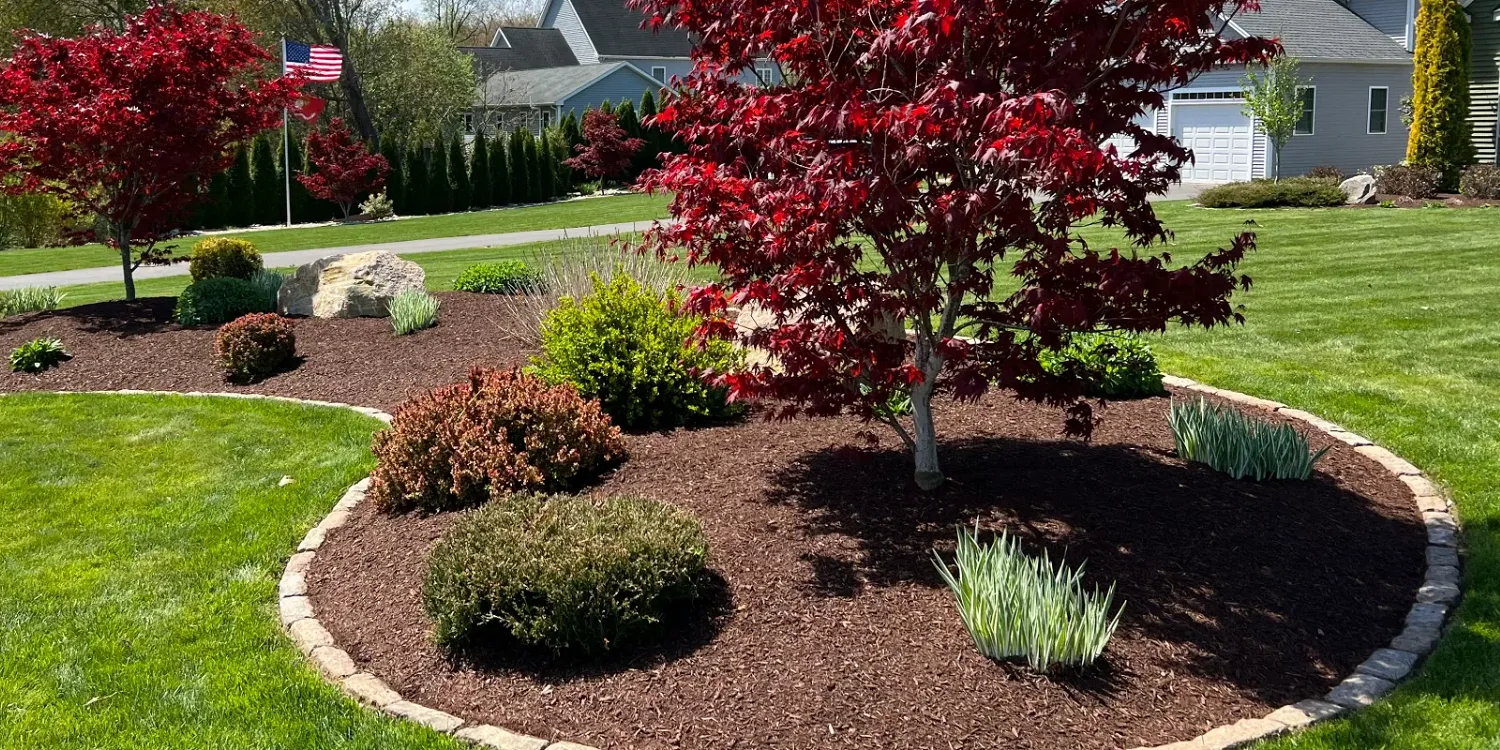
A defined bed border is one of the highest-return investments in any North Georgia landscape. It makes the property look intentional and maintained, stops Bermuda grass from creeping into beds, and holds mulch in place during summer rain events that move loose material off sloped properties. The right edging material depends on the property’s style, the bed layout, and how long you want the solution to last.
The natural cut edge — no physical material at all, just a clean line cut between the lawn and the bed with a mechanical edger or half-moon spade — is worth mentioning because it’s what a well-maintained bed looks like regardless of what edging material is underneath it. The cut edge is the visible result; the physical edging is the infrastructure that holds the line between cuts.
On Fescue properties without Bermuda rhizome pressure, a maintained cut edge without any physical edging material is a legitimate low-cost approach — provided the homeowner or their lawn service commits to re-cutting that line every four to six weeks through the growing season. Without a physical barrier, the line migrates as soil moves and grass spreads. On Bermuda properties, a cut edge alone lasts one growing season before Bermuda reclaims it from below.
Thin plastic roll edging is the most widely available edging material at garden centers and big-box stores across the North Georgia market — and it’s also the least effective choice for properties where Bermuda is the lawn grass. The limitations are predictable: at 3 to 4 inches of installation depth, Bermuda rhizomes traveling at 4 to 6 inches below the surface pass right underneath it. The lightweight material doesn’t resist the shrink-swell movement of North Georgia clay through seasonal wet-dry cycles, and in Dawsonville’s temperature extremes — hot summers, freeze-thaw winters — plastic becomes brittle and pops out of position within three to five seasons.
Rubber roll edging is a modest step up — more UV-resistant, more flexible, slightly more durable — but shares the same depth limitation for Bermuda control. On Fescue properties where underground rhizome pressure isn’t a factor, rubber edging provides adequate visual bed definition at low cost. On any Bermuda property, neither plastic nor rubber delivers the Bermuda containment that makes physical edging worth installing in the first place.
Heavy-gauge steel or aluminum edging is the most popular choice on Dawsonville’s HOA properties and Forsyth County’s newer developments. It creates a permanent, clean line between bed and lawn that holds for 10 to 20 years with minimal maintenance. Metal edging is mallet-driven with no trench required, making installation clean and non-disruptive to existing plants. It handles straight lines and moderate curves equally well and sits low enough that mower wheels can pass alongside it without scalping.
Where bed outlines involve significant curves — kidney-shaped island beds, complex foundation bed geometry — heavy-gauge plastic edging handles tight-radius curves more cleanly than metal without the cost of stone. Heavy-gauge commercial plastic, not the thin flexible strips sold at big-box stores, holds its shape and position for 5 to 10 years and is a legitimate option where curve complexity and budget are both considerations.
Stone and brick edging requires trench installation and a compacted gravel base — more labor-intensive than mallet-driven metal or plastic, and priced accordingly. But properly installed stone or brick is a permanent improvement that never needs replacement and adds material character that metal and plastic cannot match. Natural fieldstone is the most appropriate choice for Dawsonville’s wooded, naturalistic properties. Cut stone and brick complement the formal architecture of Gainesville’s established neighborhoods and Cumming’s HOA communities.
One specific application where stone and brick edging adds practical value beyond aesthetics: on sloped North Georgia properties where beds step up or down significantly from the lawn level, a stone or brick border creates a stable, structural edge that holds the grade and prevents erosion that an unbordered bed edge would experience during heavy rain events.
For full details on edging material options, pricing per linear foot, and the installation process for Dawsonville, Gainesville, and Cumming, see our Garden Bed Edging Installation page.
A fresh layer of mulch or pine straw simultaneously improves the appearance of any bed. It performs four practical jobs: suppressing weeds, retaining soil moisture through North Georgia’s summer heat, moderating soil temperature, and protecting plant roots from Zone 7b’s periodic winter cold snaps. The right material choice depends primarily on one factor that matters more in North Georgia than in most markets: slope.
On sloped beds — common across Dawson County’s hilly terrain and Gainesville’s ridge-top properties — longleaf pine straw is the clear choice. The long, dense needles interlock and grip the soil surface, holding on grades where wood mulch washes downhill in a summer storm. Longleaf specifically — not standard short-needle pine straw — has the needle length and natural resin content that produces this holding behavior on slopes. It also holds its warm reddish-brown color for 9 to 12 months.
For flat or gently sloped beds where erosion is not a concern, quality softwood mulch in black, brown, or red offers a finished, manicured appearance that suits HOA communities and formal landscape styles. Brown is the most natural-looking and most popular across Gainesville’s and Cumming’s established neighborhoods. Black gives beds a sharp, high-contrast look that makes plant foliage pop, a look common on newer Forsyth County construction.
Pro Tip
The pine straw and soil acidity concern is largely a myth in residential landscaping applications. Fresh pine needles are acidic, but as they decompose — which is when they’re functioning as mulch — their pH effect on soil is minimal. Pine straw is genuinely beneficial for acid-loving plants like Azaleas, Camellias, and Hydrangeas, which are common across all three counties. If you’ve heard that pine straw acidifies the soil excessively for other plants, this concern is overstated for most North Georgia residential beds.
The correct application depth for both mulch and pine straw is 2 to 3 inches over the soil surface. Less than 2 inches, and weed suppression and moisture retention are compromised. More than 4 inches creates anaerobic conditions at the soil surface that harm roots, and mulch piled against plant stem bases promotes crown rot and creates a bridge for termites to access the home structure.
The specific failure mode to avoid is volcano mulching — piling mulch against the trunk or stem of a tree or shrub in a cone shape. This traps moisture against the bark, promotes disease, and in trees can eventually girdle the trunk as the mulch layer compacts over the years. Mulch should always be pulled back 2 to 3 inches from all trunk and stem bases, leaving a visible clear ring around each plant.
For mulch and pine straw material options, pricing, and professional installation across Gainesville, Dawsonville, and Cumming, see our Mulch & Pine Straw Installation page.
Sod installation is the fastest way to address a lawn that seed cannot fix — the bare patches, the mud yard after rain, the patchy half-grass situation that persists through multiple growing seasons. In North Georgia’s red clay and variable terrain, sod is often not just the faster option but the only option that works reliably.
Grass seed in North Georgia faces three specific challenges that make it unreliable on most residential properties. Red clay compacts during seed germination, preventing the root contact needed for establishment. Summer heat arrives before many spring-seeded lawns can establish a viable root system. And any slope — even moderate grade — creates erosion risk that moves seed before germination is complete. Sod eliminates all three problems the moment it’s installed.
A properly installed sod lawn creates an immediate root mat that anchors the soil, establishes during the correct seasonal window, and handles North Georgia’s variable terrain far better than seed. The one exception is Fescue, which can be successfully seeded in fall when soil temperatures are cooling — but even Fescue performs more reliably as sod than seed in North Georgia’s difficult clay soil.
When sod installation is part of a larger landscaping project — new bed installation, property renovation, post-construction lawn establishment — variety selection should align with the landscaping plan rather than be made independently. A property being planted with shade-tolerant shrubs and trees that will eventually create canopy coverage needs Zoysia or Fescue from the start, not Bermuda that will fail as the canopy develops. Getting the variety right at installation saves the cost of sod replacement as conditions change.
A properly installed sod lawn creates an immediate root mat that anchors the soil, establishes during the correct seasonal window, and handles North Georgia’s variable terrain far better than seed. The one exception is Fescue, which can be successfully seeded in fall when soil temperatures are cooling — but even Fescue performs more reliably as sod than seed in North Georgia’s difficult clay soil.
For complete sod installation information, including pricing, grass variety selection, and our six-step installation process, see our Sod Installation page.
Unlike mowing — which has a clear active season and dormant season — landscaping work has optimal windows throughout the year. Knowing when each task is most effective is what separates a landscape that establishes quickly and performs well from one that struggles through its first season.
Fall is the most productive planting window in North Georgia and the least used. Plants installed in fall look dormant or slow for the first few months, which makes homeowners feel like nothing is happening. What’s actually happening is root development — the plant is establishing its root system in warm soil without supporting active top growth. That investment in root development is what produces dramatically better performance the following summer compared to spring-planted equivalents.
Spring-planted trees and shrubs go straight from the nursery into hot-summer North Georgia, trying to establish roots and support vigorous top growth simultaneously in high heat. Fall-planted equivalents arrive at summer already rooted and significantly more drought-tolerant. On Dawsonville’s wooded lots where summer water competition from mature tree root systems creates additional stress, the difference in first-season survival between fall and spring-planted material is often substantial.
For mulch and pine straw material options, pricing, and professional installation across Gainesville, Dawsonville, and Cumming, see our Mulch & Pine Straw Installation page.
A significant portion of properties across Dawsonville, Gainesville, and Cumming sit in HOA communities with defined landscaping standards. Understanding what these standards typically require and how professional landscaping helps maintain compliance is important context for any landscape project in this market.
The most common HOA landscaping mistake is installing plants that grow to the wrong mature size for the space. A shrub that looks perfectly proportioned at 18 inches at installation and grows to 6 feet at maturity requires repeated heavy pruning to maintain compliance — and repeated heavy pruning stresses the plant and creates a dense, unnatural ball shape that looks worse than the right plant would have.
Getting plant sizing right at installation — choosing shrubs whose mature height fits the space without heavy annual pruning — is the single most effective strategy for reducing long-term landscaping maintenance costs while staying in HOA compliance. This requires looking beyond the current container size and the appeal of a plant in bloom at the nursery to understand what it will become in 3 to 5 years in your specific conditions.
The North Georgia landscaping market ranges from established local companies with deep knowledge of regional conditions to services that apply the same generic approach regardless of local soil and climate. The gap in results between the two is significant, particularly for projects involving plant selection, soil preparation, and installations that need to survive North Georgia’s specific conditions.
Pro Tip
Ask specifically how a landscaping company handles a plant failure under their warranty. A company that says ‘we assess the cause first and replace it if it was our installation’ is giving you the honest answer. That’s a fair, defensible standard. A company that immediately says ‘we replace everything, no questions asked’ either hasn’t thought it through or isn’t planning to honor the warranty.
Landscaping costs in North Georgia vary significantly by scope. A standard flower bed installation with soil preparation, plants, mulch, and edging looks different for a small 50-square-foot foundation bed than for a full front-yard renovation with multiple bed areas and tree installation. Most residential landscaping projects in Dawsonville range from several hundred dollars for a single bed to several thousand dollars for a comprehensive multi-bed project with sod coordination. We provide written, itemized quotes before any work begins. Call (762) 380-2214 or submit a contact form for a free on-site estimate.
The best plants for Dawsonville's landscaping depend on your specific sun exposure, shade level, and deer pressure. For partial to full shade on wooded lots, Encore Azalea, Oakleaf Hydrangea, Loropetalum, Camellia, Hellebore, and Nandina consistently perform well. For full-sun beds, Knockout Rose, Indian Hawthorn, Boxwood, and ornamental grasses are strong choices. Deer-resistant species are a priority consideration on most Dawson County properties near wooded acreage or creek corridors. We assess your specific site conditions before recommending any plant selection.
Fall — September through November — is the best planting window for trees and shrubs in North Georgia. Zone 7b soil stays warm through November while air temperatures cool, giving root systems time to develop before summer heat arrives. Spring is the best window for sod installation, annual color, and new bed construction. Summer installation of trees and shrubs is possible but carries a higher risk of stress. Winter is an excellent time for hardscape work, edging installation, and project planning without disrupting the growing season.
Yes — for most ornamental landscaping in North Georgia, soil amendment is not optional. Native red clay with a pH of 5.0 to 5.5 is outside the preferred range for most landscape shrubs, perennials, and trees. Breaking up compaction, incorporating high-quality compost, and adjusting pH to the correct range for your plant selection are what separate installations that thrive from those that slowly decline. The exception is acid-loving plants — Azaleas, Camellias, Hydrangeas — which actually prefer the native acidic clay.
Longleaf pine straw is the right material for sloped beds in North Georgia. The long, dense needles interlock and grip the soil surface, a trait wood mulch cannot match on a grade. Longleaf specifically — not standard short-needle straw — has the needle length and natural resin content that holds on slopes even through summer storm events. If mulch is preferred over pine straw, a physical edging border at the bed's lower edge helps contain material, combined with an application depth of 2 to 3 inches.
Metal edging — heavy-gauge steel or aluminum — is the most popular choice for HOA properties in Dawsonville, Gainesville, and Cumming because it creates a permanent, clean line that lasts 10 to 20 years. Natural fieldstone suits Dawsonville's wooded, naturalistic aesthetic. Brick and cut stone complement the formal character of established Gainesville and Cumming neighborhoods. Thin plastic edging from big-box stores is not a durable solution in North Georgia's freeze-thaw cycles and UV exposure.
Bermuda and Zoysia sod installation is best done from April through August in North Georgia. Tall Fescue sod installation requires cool soil temperatures — September through November is the correct window. A summer Fescue installation in North Georgia's heat will fail. Centipede sod is best installed from May through July. Timing sod installation correctly for the grass variety is as important as the installation process itself.
No. We handle everything from the initial site assessment through plant selection, soil preparation, installation, and aftercare instructions. Homeowners who have never done a landscaping project and those with detailed plans both work well with us — we adjust our process to match what you know and what you want. The site visit and consultation are free, with no obligation to book after. Call (762) 380-2214 or submit our contact form to get started.
Monday – Friday:
8:00 am to 5:00 pm
Saturday & Sunday:
Closed
Copyright 2026 © All Rights Reserved.