
North Georgia's Sod Installation Specialists
New lawn installation and sod replacement serving Gainesville, Dawsonville, and Cumming, GA
If you’re reading this, you’ve probably already figured out that seed isn’t going to fix what you’ve got. The mud yard after every rain. The bare patches where nothing takes hold. The patchy half-grass, half-clay situation that no amount of fertilizer has solved. You know sod is the answer. What you’re not sure about is who to trust, which grass to choose, and whether the price you’ve been quoted is fair.
That’s exactly what this page is for. Dawsonville Lawn Pros has been installing sod across Hall, Dawson, and Forsyth Counties for 10+ years. We know the difference between what works on a sun-drenched Forsyth County subdivision lot and what a shaded Dawson County property actually needs. We publish our prices so you don’t have to guess. And we’ll tell you straight which grass variety gives you the best result for your specific yard — not the one with the highest margin for us. We handle both new lawn installations and sod replacement — whether you’re starting from bare dirt or replacing a lawn that thinned out, failed, or was damaged beyond recovery.
Why Sod Wins in North Georgia — Especially on These Soils
Grass seed is a gamble in North Georgia’s red clay. The soil compacts, the summer heat arrives before germination is finished, and a single hard rain can wash exposed topsoil — and your seed investment — straight down the slope. Sod eliminates every one of those vulnerabilities the moment it goes down.
Other Services
Maintenance
Landscaping
Sod Installation Downloads
What Sod Does That Seed Can Never Match
- Instant erosion control — a dense root mat locks your red clay in place from day one, even on Dawson County’s steep terrain
- Same-day transformation — no waiting 6–12 weeks for fill-in; your yard is finished when our crew leaves
- Weed suppression from installation — quality sod arrives virtually weed-free and crowds out competition from the start
- Reliable establishment — professionally installed sod has a dramatically higher success rate than seed in Zone 7b’s summer heat
- Immediate property value lift — appraisers and buyers notice a finished lawn; a mud yard communicates neglect regardless of the house
Get a Straight Answer
We visit your property, measure every square foot, and give you a written quote broken down by grass type and prep work. No surprises.
Our Sod Installation Process — The Prep Is the Product
Ask any experienced sod installer what kills a new lawn and they’ll tell you the same thing: bad soil preparation. The sod itself is just grass. What determines whether it thrives for ten years or dies in six weeks is what happened to the ground underneath it before the first roll was laid. Here is every step our crew executes on every project — and why it matters specifically for North Georgia soil conditions.
1
Site Walk & Soil Read
Before we write a single number on your quote, we walk your entire property. We’re looking at drainage flow lines, tree canopy coverage, grade changes, existing vegetation type, and soil composition. In Hall, Dawson, and Forsyth Counties, we’re almost always dealing with acidic red clay — but the degree varies block to block. We identify what you require before your installation date is ever set.
2
Full Vegetation Removal — No Shortcuts
Old grass, weeds, and dead turf come out completely. Installing over existing vegetation is the single most common way sod fails — the old material prevents root-to-soil contact, traps moisture, and creates a fungal breeding ground. We remove it all, without exception. There is no scenario where we lay new sod over old growth.
3
Drainage Grading
Water that pools under new sod is a death sentence for your investment. We establish a positive drainage grade away from your home’s foundation and eliminate low spots before the sod arrives. On sloped properties — common across Dawson County and the Lake Lanier corridor — we also set the grade to control runoff velocity and prevent the erosion channels that form when water finds a path.
4
Clay Correction & Soil Amendment
North Georgia’s red clay sits naturally between pH 5.0 and 5.5 — too acidic for most warm-season grasses to thrive. We break up compaction, add compost or quality topsoil as the site requires, and adjust pH toward the 6.0–6.5 range that Bermuda and Zoysia prefer. Centipede is the one exception — it actually performs best in the 5.0–6.0 range your native clay already provides. We match the amendment to the variety you’re installing.
5
Precision Sod Laying & Rolling
Fresh-cut sod is delivered the morning of installation and goes down the same day — sod that sits on a pallet in summer heat begins to deteriorate within 48 hours. We lay in a staggered brick pattern to eliminate visible seams, cut edges clean around beds, walkways, and hardscape, and roll the entire surface to maximize soil contact and remove air pockets. On slopes, we stake rolls to prevent slippage during the establishment window.
6
First Soak & Your Written Care Schedule
Before we leave, your new sod receives a deep initial soaking and you receive a written aftercare guide specific to the grass variety installed and the time of year. We walk you through watering frequency, the pull test that confirms rooting, first mow timing, and what to watch for during North Georgia’s summer heat. You are never left guessing what comes next.
We've Installed Hundreds of Lawns.
Let's Plan Yours!
Our process is the same on every project because consistent preparation is what produces consistent results.
Which Grass Is Right for Your North Georgia Property?
TifTuf Bermuda
Tall Fescue
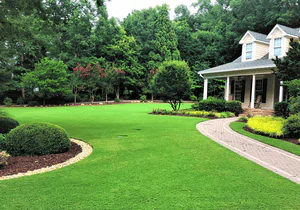
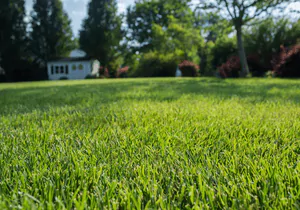
Best installed: April – September
Best for: Full sun, high-traffic yards
Bermuda sod installation is the most common request we handle across North Georgia — heat-tolerant, traffic-durable, and economical to install. 419 Bermuda is the most common and budget-friendly option, thriving in the open, sun-drenched lots typical of Forsyth County’s newer developments. Tif Tuff are bred for heavier foot traffic — ideal for families with kids, pets, or yards that double as the neighborhood gathering spot. All Bermuda varieties go dormant (tan) from November through mid-March in USDA Zone 7b. Not suitable for shaded lots with more than 30% tree canopy coverage.
Best installed: September – November
Best for: Heavy shade, year-round green
Tall Fescue sod installation is the only cool-season option we offer and the only answer for yards where warm-season grasses cannot survive, under mature tree canopies where light is severely limited. Fescue stays green year-round in Zone 7b, a significant advantage for homeowners who can’t tolerate the dormancy period of Bermuda and Zoysia from November through early April. Fall installation (September–October) is critical — Fescue needs cool temperatures to establish its root system. Installing mid-summer in North Georgia’s heat isn’t recommended and will likely fail.
Zoysia Sod (Zeon / Zenith)
Centipede
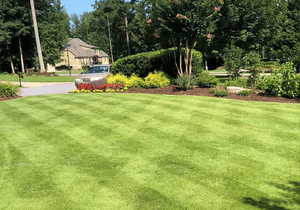
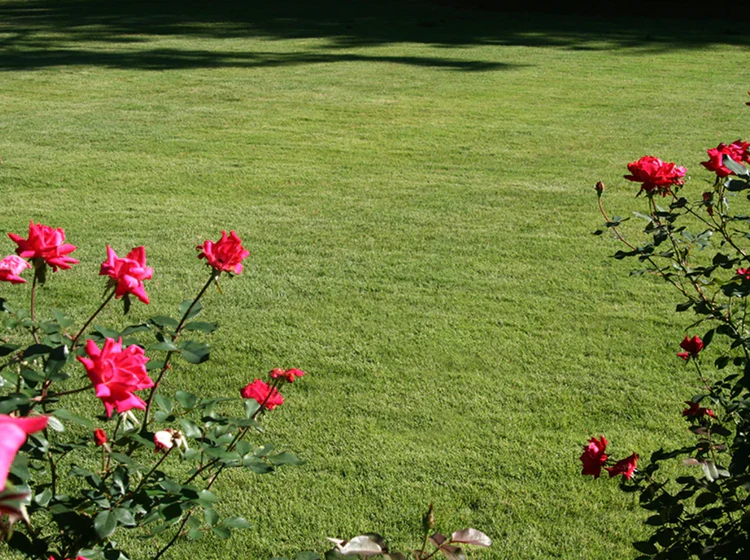
Best installed: May – August
Best for: Part shade, premium low-maintenance
Zoysia sod installation is the premium warm-season choice and the right answer for Dawson County’s wooded properties and any yard with significant afternoon shade. Zeon Zoysia — our most popular install — is fine-bladed, tolerates up to 60% shade, and creates a dense, carpet-like surface that naturally chokes out weeds without much chemical intervention. Zenith handles moderate shade and is one of the best choices for transitional yards where sun patterns shift seasonally. Zoysia takes slightly longer to establish (6–10 weeks for full rooting in North Georgia) but requires significantly less water and maintenance once it’s in.
Best installed: May – July
Best for: Acidic red clay, ultra-low maintenance
Centipede sod installation is North Georgia’s most underappreciated sod option — and the one variety that doesn’t fight your native soil, it works with it. Unlike Bermuda and Zoysia, which require pH correction toward 6.0–6.5, Centipede thrives in the 5.0–6.0 acidic range that Hall, Dawson, and Forsyth County red clay naturally provides. That means less soil amendment, lower installation cost, and a grass that doesn’t need to be convinced to grow here. Centipede is slow-growing (requiring fewer mowing sessions), requires minimal fertilization, and produces a medium-textured lawn that looks clean and well-maintained with very little ongoing effort. Ideal for homeowners who want an attractive yard without a demanding maintenance schedule.
Sod Installation Pricing — What You'll Actually Pay
We publish our pricing because we believe you should have a real number before you ever pick up the phone. The table below reflects our current installed price ranges by grass type for standard residential projects in Hall, Dawson, and Forsyth Counties. Every project that requires significant grading, clay correction, or slope work is quoted separately based on what your specific site needs — that detail is part of your free on-site estimate.
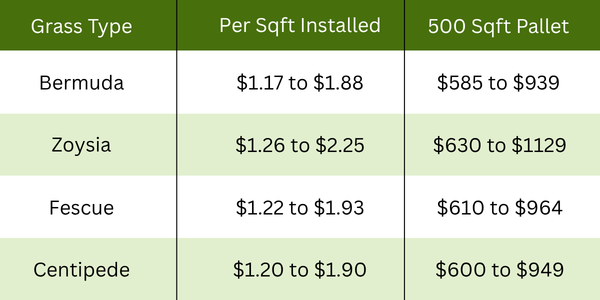
Every price above includes delivery, installation, rolling, starter fertilizer, and your first watering. Projects with significant slope work, existing hardpan clay, or large square footage (3,000+ sq. ft.) may require a separate soil amendment line item — we identify this during your free site walk, never after the job starts.
Pricing is per square foot — the larger your project, the lower your per-square-foot cost. A 6,000 sq ft installation will come in at the lower end of the range; a single 500 sq ft pallet will come in at the higher end. Every quote is written specifically for your yard — call us and we’ll give you an exact number.
That's a Starting Point...
Get Your Free Estimate
We measure your yard, assess your soil, and give you a written breakdown with no guesswork and no hidden prep charges.
The team did an excellent job laying down sod in my front yard. It’s made a world of difference, and the new grass looks so good. Highly recommend!
I was on the fence about installing sod, but after seeing the results, I’m glad I did it. My yard is beautiful and ready to enjoy. The installation was done perfectly.
The sod installation was smooth and hassle-free. My yard now has a lush, green lawn that looks brand new. I’m very satisfied with the service!
Our Service Area — Hall, Dawson & Forsyth Counties
Dawsonville Lawn Pros provides sod installation services throughout North Georgia’s three-county corridor. We understand the terrain, soil, and seasonal conditions that vary across these communities — because we’ve been working in them for 10+ years.
Gainesville, GA
Dawsonville, GA
Cumming, GA
Not sure if we reach your address? Call 762-380-2214 and we’ll confirm your location in under a minute.
Frequently Asked Questions — Sod Installation in North Georgia
In Hall, Dawson, and Forsyth Counties, installed sod prices currently range from $1.20 to $2.25 per square foot, depending on the grass variety — Centipede and Bermuda on the lower end, and Zoysia on the higher end. A standard 500 sq. ft. pallet runs $585–$1129 installed. Projects requiring significant soil amendment, grading, or slope preparation are priced separately based on your specific site, which is exactly what we assess during your free estimate. We provide a written breakdown before any work begins.
North Georgia's red clay is naturally dense, poorly draining, and acidic — typically with a pH of 5.0–5.5. Most warm-season grasses prefer a pH of 6.0–6.5, which means your clay soil actively works against Bermuda and Zoysia unless it's corrected before installation. Unaddressed clay also compacts around new roots, creating drainage problems that suffocate sod during North Georgia's rainy spring season. Proper soil amendment isn't optional here — it's what determines whether your investment succeeds or fails within the first season.
For heavily shaded properties — typical of Dawson County's wooded terrain and forested lots — Zeon Zoysia is our strongest recommendation for warm-season performance. It tolerates up to 60% shade and establishes well in North Georgia's growing season. For yards where shade is so dense that warm-season grasses can't survive (under thick canopies of hardwoods or pines), Tall Fescue installed in September–October is the right answer. It stays green year-round and handles the deep shade that Bermuda and even Zoysia can't manage. We assess your shade patterns during the free site walk and give you a straight recommendation.
Centipede is the only warm-season grass that genuinely prefers the acidic conditions — pH 5.0–6.0 — that North Georgia's red clay naturally provides. While Bermuda and Zoysia installations in this region require soil amendment to raise pH, Centipede can be installed with significantly less prep because the soil already suits it. It's slow-growing (fewer mowing sessions per season), requires minimal fertilization, and produces a clean, medium-textured lawn with very little ongoing maintenance. For homeowners in Hall, Dawson, and Forsyth Counties who want a low-input yard, Centipede is a seriously underrated choice.
Yes — and sod is far superior to seed on slopes, which is one of the most common situations across Dawson County and the Lake Lanier corridor. Sod's established root mat immediately controls erosion. Seed on a slope is vulnerable to washout during North Georgia's spring rain events before germination is complete. On steeper grades, we stake sod rolls with biodegradable stakes to prevent slippage during the establishment window, and we closely monitor the drainage grade to prevent erosion channels from forming at the base of the slope. Slope work is included in your free estimate and quoted.
For warm-season varieties (Bermuda, Zoysia, Centipede) installed during North Georgia's primary growing season, you can expect the pull test to confirm root anchoring in 2–3 weeks, and full establishment — suitable for normal use — in 6–8 weeks. Zoysia runs slightly longer, typically 6–10 weeks, because of its denser growth habit. Fescue installed in fall takes longer to show visible density but will fill in fully by spring. North Georgia's summer heat accelerates establishment compared to cooler climates, but it also increases the stakes around watering during that critical first window.
We don't offer a warranty on the sod itself, and we'll explain why: sod establishment depends significantly on what happens after we leave — specifically, how consistently it's watered during the first 3 weeks. A warranty on sod damaged by underwatering would be priced into every project, regardless of whether the homeowner follows the care schedule. Rather than raising prices to cover that risk, we invest in a high-quality installation and a thorough, written aftercare guide that makes success straightforward. Our artistry is what matters. If the installation causes a problem, we'll come back and fix it.
A few things stand out. First, we publish our pricing — you can see the range for every grass variety before you call us, because we think you deserve that information upfront. Second, we've been in North Georgia for 11 years, which means we're not applying generic sod installation practices — we know the soil, slope conditions, county-by-county terrain differences, and which grass performs best in which setting here. Third, we cover Centipede, which many local installers skip. And fourth, we're family-owned with a local reputation we care about — which means we're not moving on to the next job until this one is right.