John Wilson is the owner of Dawsonville Lawn Pros and a U.S. Navy veteran. He graduated magna cum laude from Texas A&M University and holds a master’s degree from Columbia Southern University. Before founding Dawsonville Lawn Pros in 2015, he built his professional foundation in industrial safety management. This background shaped the disciplined, detail-oriented approach he brings to every property he serves.
Quick Answer
Bermuda grass in Dawsonville typically breaks dormancy in late March to early April — one to two weeks later than Metro Atlanta. Regular mowing begins when the lawn is 75 to 80 percent green, usually mid-April. Weekly mowing is required from May through mid-September. The final mow of the season falls in late October or early November as growth slows heading into dormancy. Common Bermuda should be maintained at 1.5 to 2 inches; hybrid varieties like TifTuf at 1 to 1.5 inches throughout the growing season.
If you’ve followed a Bermuda mowing calendar written for Metro Atlanta — or a generic Georgia lawn guide — and found that the timing felt off on your Dawsonville property, you weren’t imagining it. Dawson County sits in USDA Hardiness Zone 7b, in the foothills of the Blue Ridge Mountains. That elevation difference creates a microclimate that consistently runs one to two weeks behind Atlanta’s seasonal timeline on both ends of the growing season.
Bermuda grass in Dawsonville breaks dormancy later than in Atlanta — typically late March to early April rather than mid-March. It goes dormant earlier in the fall —usually mid-to-late October — compared to early November in Metro Atlanta. That means the active mowing season in Dawsonville is approximately 26 to 28 weeks, versus 30 to 32 weeks in Atlanta. The schedule has to reflect that difference, or you’re either starting too early in spring (mowing dormant or semi-dormant grass that isn’t ready) or holding on too long in fall (mowing after the lawn should be preparing for dormancy). If you’re maintaining other turf types on your property alongside Bermuda — Fescue, Zoysia, or Centipede — our Complete Guide to Lawn Care in North Georgia covers how the regional timing affects each one.
There’s also a terrain-and-canopy variable that Metro Atlanta guides don’t address. Dawsonville’s wooded properties — particularly those with significant White Oak or Hickory canopy — see later green-up and earlier fall slowdown than open subdivision lots in Forsyth County. If your lawn has heavy shade, build an extra week of buffer into both the start and end of the mowing season compared to the calendar below, which is calibrated for open or lightly shaded HOA lots.
For a full look at how regional microclimates affect turfgrass timing in Georgia, UGA Extension’s turfgrass management resources provide county-level guidance.
Pro Tip
The most reliable cue for when to start regular mowing in Dawsonville is not the calendar — it’s the lawn itself. When your Bermuda is 75 to 80 percent green, and the grass has reached your target mowing height, it’s time to begin your regular schedule. In Dawsonville, this typically falls between April 10 and April 25, depending on the year, but soil temperature and the previous winter’s severity can shift it in either direction
The mowing height and, to some extent, the mowing frequency for your Bermuda lawn depend on which variety you have. Dawsonville’s HOA community lots are predominantly planted with one of two categories: common Bermuda (the variety most often established from seed on older properties and some builder-grade lots) or hybrid Bermuda (sod varieties like TifTuf, Tifway 419, and Celebration that are commonly used in newer installations and sod replacements).
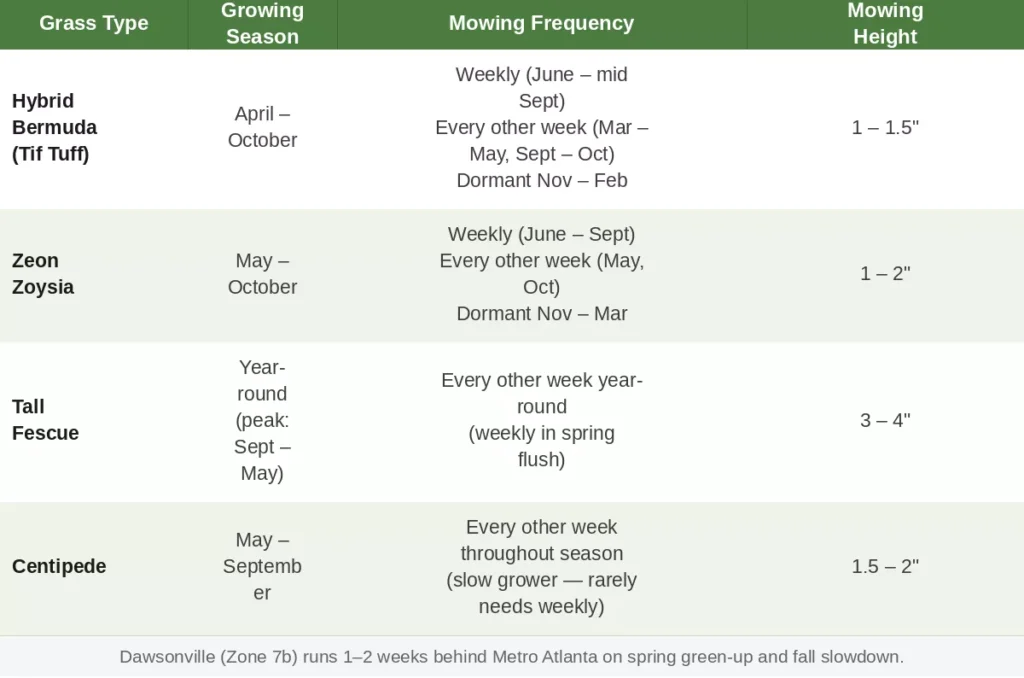
How do you know which variety you have? If your lawn was established from seed, it is almost certainly common Bermuda. If it was installed as sod within the last 10 to 15 years — particularly in a newer Dawsonville HOA community — it is likely a hybrid variety. The visual difference: hybrid Bermuda has finer, softer blades and a denser, more uniform texture. Georgia Turf’s variety selection guide breaks down the performance characteristics of each hybrid variety, so you can confirm what’s on your property. Common Bermuda has slightly coarser blades and a more open texture at the same mowing height.
The practical difference in mowing: hybrid varieties perform better at lower mowing heights (1 to 1.5 inches) and look noticeably better when mowed frequently at that height. Common Bermuda at 1 to 1.5 inches risks scalping on uneven terrain — the 1.5 to 2 inch range gives you a better safety margin on the varied topography of Dawsonville’s lots.
The following schedule is calibrated for Bermuda lawns on open-to-lightly shaded HOA properties in Dawsonville and Dawson County. Properties with heavy hardwood canopies may lag one to two weeks behind these timelines at both the start and end of the growing season.
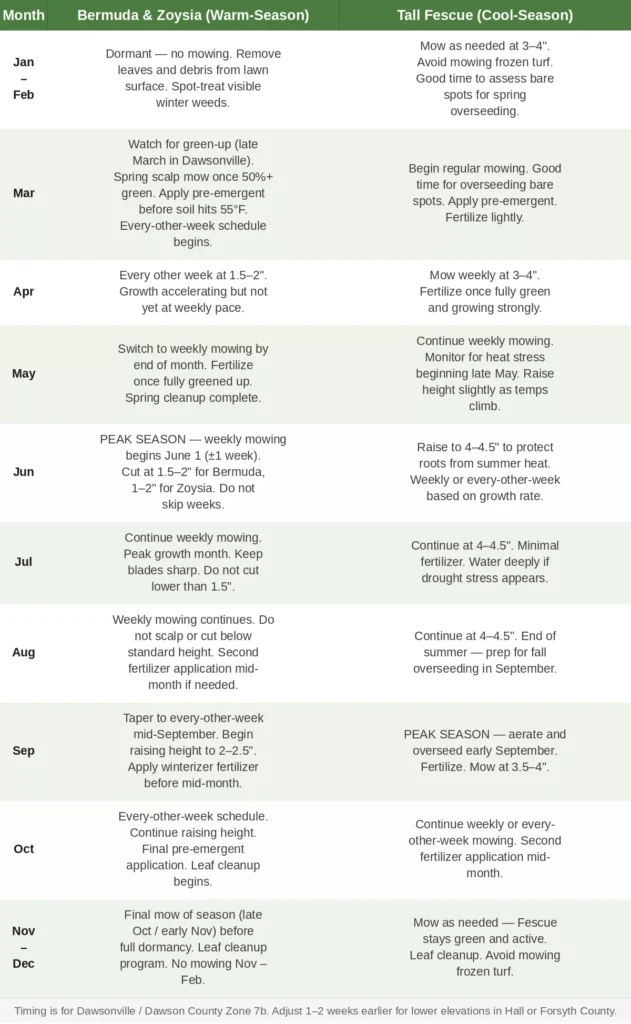
Your Bermuda lawn is fully dormant through January and February in Dawsonville. The grass is brown, root growth has stopped, and any mowing during this period would be pointless at best and damaging at worst — mowing dormant Bermuda removes thatch that’s protecting the crown without providing any of the growth management benefits mowing delivers during the growing season.
What does matter in January and February is the soil surface. Keep it clear of leaf debris and organic matter — a mat of wet leaves sitting on dormant Bermuda through winter holds moisture against the crown, blocks the limited light the dormant grass still needs, and creates the conditions for Large Patch and Brown Patch fungal disease that shows up as irregular brown patches in spring.
February is also when the pre-emergent window opens. Crabgrass seeds in Dawson County’s red clay begin germinating when soil temperatures reach 55°F at a 4-inch depth — typically late February to mid-March, depending on the year. Apply pre-emergent before that threshold, not after. Once crabgrass has germinated, pre-emergent is ineffective for the rest of the season.
March is the most consequential month in the Dawsonville Bermuda mowing calendar, and the month where the most common mistakes happen. Two things need to occur in March in the right order.
First: the scalp mow. Scalping is the practice of mowing Bermuda significantly shorter than the normal growing-season height — typically down to 0.75 to 1 inch — one time in early-to-mid March to remove accumulated thatch, dead tissue, and winter debris. This clears the crown area, allows better light penetration to the soil surface, and accelerates spring green-up by letting the soil warm faster. Done at the right time, scalping is beneficial. Done too early — before the last frost risk has passed — it exposes the crown to cold damage.
In Dawsonville, the last frost date averages between late March and early April. Do not scalp until you are confident the season’s freeze risk has passed. Watching the 10-day forecast in March and targeting a scalp mow window after a confirmed warming trend is the practical approach. After the scalp mow, bag the clippings — the removed material is significant and should not be left on the lawn surface.
Second: monitor for green-up. In Dawsonville’s Zone 7b foothills climate, the first visible green-up on Bermuda typically appears in the low-lying areas of the property and on south-facing exposures, usually between late March and the first week of April. When the lawn is 75 to 80 percent green and has reached mowing height, regular mowing begins.
Pro Tip
The scalp mow timing question comes up every year. The simple rule for Dawsonville: if the 10-day forecast shows no overnight lows below 35°F after the mow date, the frost risk is low enough to proceed. Early scalping that catches a late frost produces stressed, slow-recovering turf. Waiting two extra weeks costs nothing.
April marks the official start of the Bermuda mowing season in Dawsonville, but it’s not a full weekly schedule from day one. Early April typically warrants every-other-week mowing as the lawn is ramping up from dormancy to active growth. The growth rate in early April doesn’t yet justify weekly visits — the grass isn’t putting on enough new height in seven days to require cutting.
By late April, most Dawsonville Bermuda lawns have accelerated to the point where the weekly schedule begins. The cue is simple: if the lawn needs it every week to stay at the correct height without violating the one-third rule, you start mowing weekly. If the lawn can go 10 to 14 days without falling below one-third of the target height, continue the biweekly schedule until growth rate demands a switch.
April is also when the lawn communicates what winter left behind. Patchy areas, irregular green-up, and brown spots that don’t fill in as the rest of the lawn greens up are signals worth noting. Some will recover on their own as warmth increases. Persistent bare or thin patches by late April may indicate fungal damage from winter leaf mat, or areas where the turf was stressed going into dormancy.
May and June represent the period of the highest Bermuda growth rate in Dawsonville. The combination of warm soil temperatures, long days, and typically adequate rainfall creates the conditions where Bermuda grows fast enough that a weekly mowing schedule is genuinely required — not preferred, required — to maintain the lawn at the correct height without violating the one-third rule in a single cut.
A Bermuda lawn during peak growth in May can put on 1.5 to 2 inches of new height in a week at Dawsonville’s temperatures. If the target height is 1.5 to 2 inches, the lawn may reach or exceed that height by day seven. Cutting it back to target requires removing nearly half the blade in a single pass — significantly more than the maximum one-third. The consequence is scalping: a stressed, brown-tinged lawn that looks worse than if it had been mowed on schedule.
Homeowners who try to save money by extending mowing intervals during May and June consistently end up with weaker lawns, more weed pressure, and a less finished appearance — particularly in HOA communities where consistent density matters for appearance standards. Weekly mowing during May through mid-September is the correct schedule — if you need a reliable weekly service for your Dawsonville HOA property, see how our lawn mowing program works.
July and August bring Dawsonville’s highest temperatures and the greatest risk of heat and drought stress on Bermuda lawns. The mowing schedule stays weekly throughout this period, but a few specific adjustments reduce the stress on the grass during the hottest stretch of the year.
The most important factor is the time of day for mowing. The worst time to mow Bermuda in summer is late afternoon — the lawn has been accumulating heat stress through the day, and mowing removes the blade area that is providing some shade to the soil surface and crown. Morning mowing (8 AM to 11 AM) is ideal: temperatures are lower, dew has dried, and the lawn has the rest of the day to begin recovering from the cut. Avoid mowing in the heat of the afternoon when temperatures are 90°F or higher.
The second adjustment is watering timing. If your Bermuda lawn is showing drought stress signals — a blue-grey tinge to the blades, or footprints that remain visible for more than a few minutes after walking across the lawn — it needs water before the next mow. Mowing stressed, drought-affected Bermuda further stresses it and slows recovery. If the lawn is stressed, water first, let it recover for a day or two, then mow. UGA Extension’s publication on Bermuda lawn irrigation explains how to read drought-stress signals and calculate water needs by season.

September is the transition month. Growth slows noticeably as day length shortens and temperatures cool, particularly at night. Two changes occur to the mowing program in September: frequency tapers from weekly to every other week as the growth rate drops below the level that requires a weekly cut, and mowing height increases from the summer height to 2 to 2.5 inches.
Raising the mowing height in September is not optional — it’s one of the most important preparations for dormancy. The additional blade height provides insulation for the crown going into winter, gives the grass more photosynthetic surface area during the shortened days of fall, and physically shades the soil surface to reduce the temperature swings that can stress the crown as nights cool.
September is also the final window for fertilizer applications. A winterizer application in mid-September — low nitrogen, higher potassium — helps the grass store energy reserves in the root system for winter and spring green-up. Do not fertilize after mid-September in Dawsonville: late nitrogen stimulates new growth that goes into cold weather, which is too tender to survive the first frost.
October mowing continues on an every-other-week schedule as growth progressively slows. By late October, most Dawsonville Bermuda lawns are approaching dormancy — the grass is still technically growing, but barely. The last mow of the season should happen when you confirm that active growth has genuinely stopped, not when a calendar date tells you to stop. In Dawsonville, that typically falls between late October and early November, depending on the year.
The final mow height should be 2 to 2.5 inches — the raised height established in September. Do not scalp or cut short before dormancy. The additional height going into winter provides crown protection. Cutting short before dormancy exposes the crown to frost damage.
October is also the beginning of the leaf cleanup season. On Dawsonville’s wooded properties, managing leaf accumulation on the dormant or near-dormant lawn becomes the primary task as deciduous species begin dropping their leaves. A wet leaf mat sitting on dormant Bermuda through winter is the single most common cause of the fungal damage and uneven spring green-up that frustrates homeowners every April. Our fall leaf cleanup and seasonal property reset services handle the debris load that comes with Dawsonville’s heavily wooded properties before it sits on your lawn all winter.
Getting the mowing height right for your specific Bermuda variety is more important than any other single mowing decision. Too short and you scalp the lawn, stress the root system, and open the turf to weed invasion. Too tall and the grass develops thatch, loses its tight, dense character, and requires a scalping event to get back to the right height, which itself causes stress.
Common Bermuda performs best at 1.5 to 2 inches in Dawsonville’s conditions. The coarser blade structure and the typically uneven terrain of older Dawsonville lots make the lower end of the range (1.5 inches) the practical minimum — going shorter risks scalping where the terrain dips. At 1.5 to 2 inches, common Bermuda stays dense, spreads laterally (which fills in thin areas), and maintains the finished appearance that HOA communities require.
Hybrid varieties like TifTuf, Tifway 419, and Celebration have finer blades and a denser growth habit, which respond well to lower mowing heights. At 1 to 1.5 inches, these varieties produce the carpet-like appearance that makes them premium choices for HOA communities. On perfectly flat lots, hybrid Bermuda can be mowed as low as 0.75 inches with a reel mower — but on Dawsonville’s naturally variable terrain, 1 to 1.5 inches with a rotary mower gives you the density benefit without the scalping risk on minor grade changes.
The standard growing-season heights above apply from green-up through late August. Two seasonal adjustments apply to every Bermuda lawn in Dawsonville, regardless of variety:
The one-third rule is the single most important principle in Bermuda mowing, and the most frequently violated. The rule is simple: never remove more than one-third of the grass blade height in a single mowing. If your target height is 1.5 inches, you should mow before the lawn exceeds 2.25 inches. If your target is 2 inches, mow before it exceeds 3 inches.
Violating the one-third rule — cutting off more than one-third in a single pass — is called scalping. Scalped Bermuda shows a brown, ragged appearance immediately after mowing as the mower removes the green blade tissue and exposes the brown, leafless stem beneath. The visible damage recovers in a few days as new growth emerges. Still, the stress on the root system is real: heavy blade removal forces the plant to divert energy from root development to leaf replacement, weakening the turf’s drought tolerance and disease resistance over time.
In practical terms, the one-third rule supports weekly mowing during the peak growing season. During May through mid-September in Dawsonville, a Bermuda lawn at 1.5 to 2 inches can put on enough growth in 7 to 10 days to push it to or past the one-third limit. Every-other-week mowing during peak growth consistently violates the rule, which is why every-other-week Bermuda lawns in Dawsonville during summer consistently look worse than weekly-mowed lawns maintained at the same height.
Pro Tip
If you come back from vacation or miss a week and the lawn has gotten significantly ahead, do not try to get back to target height in a single mow. Take it down one-third this week, then back down toward the target next week, and full target height the week after. Three passes spread over 10 to 14 days get the lawn back to target without the scalping damage that a single hard cut would cause.
Here is the complete Bermuda mowing frequency guide for Dawsonville, organized by the practical growing conditions of each season.
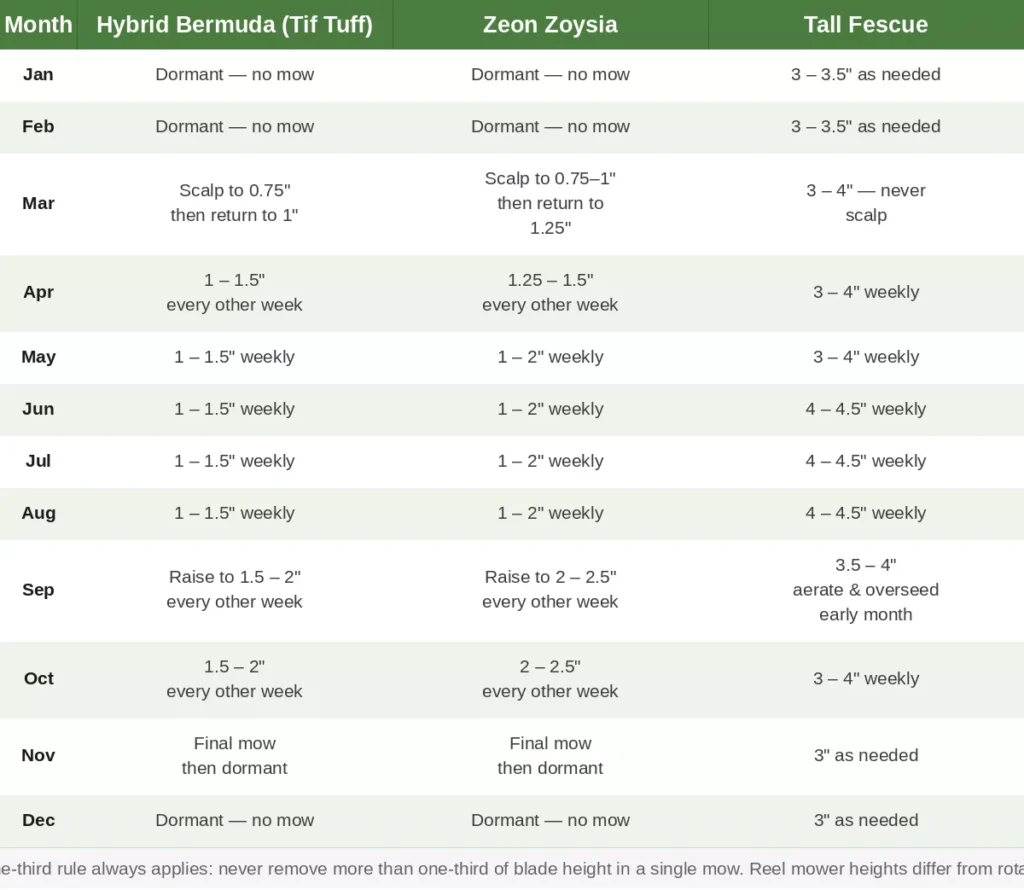
After 10 years of maintaining Bermuda lawns across Dawsonville and Dawson County, these are the mowing mistakes we see most often — and the ones that cause the most recoverable and sometimes lasting damage to Bermuda turf.
The combination of biweekly mowing and a target height below 1.5 inches during peak season is a guaranteed recipe for scalping. A lawn cut to 1.5 inches and left for two weeks in June will be at 3 inches or more — cutting it back to 1.5 inches removes half the blade in a single pass. The resulting brown, stressed appearance is the most common Bermuda complaint we hear from homeowners who switched from weekly to biweekly service during summer to save money. The apparent savings disappear when the lawn requires remedial work.
Scalping before the frost risk has passed in Dawsonville exposes the turf crown to late-winter cold snaps. A late March freeze event after an early scalp mow can damage Bermuda crowns that had been protected by the thatch layer and are now exposed. The result is a slow, uneven spring green-up with patches that lag weeks behind the surrounding turf. In Dawsonville, confirm a sustained warming trend with no forecast overnight lows below 35°F before scalping.
Lawns mowed at summer height, going into dormancy in Dawsonville, have less crown protection through winter than lawns raised to 2 to 2.5 inches in September. This is particularly consequential for properties with cold-air drainage from surrounding terrain — low-lying areas of Dawson County’s hilly landscape that collect cold air on still nights can experience temperatures several degrees colder than those on the surrounding hillsides. The additional blade height provides meaningful insulation in these conditions.
Mowing Bermuda while wet — dew-covered in the early morning, or immediately after rain — produces poor results regardless of season. Wet grass doesn’t cut cleanly: mower blades tear rather than cut, leaving ragged, browning blade tips. Wet clippings clump rather than distribute evenly across the lawn, creating matted piles that block light and promote fungal conditions underneath. Always let the lawn dry for at least two hours after rain or morning dew before mowing.
Dull mower blades rip rather than cut grass blades. The ragged edges created by dull blades are more susceptible to fungal infection — the torn tissue is a direct entry point for pathogens — and the shredded blade tips produce the brown, frayed appearance that makes a freshly mowed lawn look worse than before it was cut. Sharpen rotary mower blades at least once per season, and more often if you’re mowing regularly on a half-acre lot. If you can visibly see a dull, bent, or chipped edge when you inspect the blade, sharpen it before the next mow.
A significant portion of Bermuda lawns in Dawsonville sit in HOA communities with defined appearance standards. Understanding what those standards practically require — and how a correct mowing schedule satisfies them — removes the stress of wondering whether your lawn meets requirements.
Here is the practical reality: a Bermuda lawn maintained on a correct weekly schedule from late April through mid-September, at the right height, with consistent edging and blowing after each visit, will never be cited by an HOA for lawn appearance violations. The compliance problem almost always comes from one of two places: an extended gap in mowing that lets the lawn get significantly ahead, or a lawn that was never properly established and has thin, weedy turf that looks poor regardless of mowing frequency.
For the first problem, the solution is a reliable mowing schedule. For homeowners who need a consistent, professional mowing program that keeps them out of HOA trouble, our Dawsonville lawn mowing service covers weekly and biweekly scheduling for HOA properties. For the second, the answer starts with understanding whether the existing turf is worth maintaining or whether a renovation — sod installation, improved soil preparation, the right variety for the sun and conditions — would produce a better result for the long term.
Begin regular mowing in Dawsonville when your Bermuda lawn is 75 to 80 percent green and has reached mowing height. In Zone 7b, this typically occurs between April 10 and April 25 depending on the year — about one to two weeks later than Metro Atlanta. Do not start mowing because a calendar date tells you to; let the lawn's green-up percentage be your guide. One scalp mow in March (after the last frost risk has passed) precedes the regular mowing season.
Weekly mowing is required from May through mid-September in Dawsonville's climate. During peak growth — June through mid-August — Bermuda can grow fast enough to require mowing every 5 to 7 days to stay within the one-third rule at the target height of 1.5 to 2 inches. Every-other-week mowing during this period consistently results in scalping during each visit and produces a weaker, less dense lawn over the season.
Common Bermuda on Dawsonville's typical HOA lots should be mowed at 1.5 to 2 inches throughout the growing season. Hybrid Bermuda varieties (TifTuf, Tifway 419, Celebration) perform best at 1 to 1.5 inches. In September, raise the height to 2 to 2.5 inches for both varieties as the lawn approaches dormancy. The spring scalp mow is the one exception — bring the height down to 0.75 to 1 inch one time only, then return to growing-season height.
Bermuda grass in Dawsonville begins entering dormancy in October as day length shortens and nighttime temperatures drop consistently below 50°F. Full dormancy typically arrives by mid-to-late November, though the timing varies by year and property conditions. Properties with heavy shade or cold air drainage from surrounding terrain tend to go dormant slightly earlier. The practical signal is that active growth has stopped — the lawn is not putting on new height between visits. The last mow of the season should align with that timing, not a fixed calendar date.
Green-up timing in Dawsonville varies by several factors: sun exposure (south-facing, open lots green up earlier than shaded or north-facing properties), soil temperature (soils that warmed earlier in the season support earlier green-up), and elevation (properties at higher elevation on Dawson County's ridges tend to green up slightly later than lower-lying lots). If your neighbor has an open, south-facing lot and yours has significant hardwood canopy, a two-week or more difference in green-up timing is completely normal and not a sign of a problem with your lawn.
Every-other-week mowing is appropriate during the transition periods — early April before growth accelerates, and October through the final mow in November. It is not sufficient during peak growing season (May through mid-September). During that window, Bermuda growth rates in Dawsonville's climate make biweekly intervals almost guaranteed to produce scalping at every mow — the grass grows too much in 14 days to cut back to target height without removing more than one-third of the blade. If budget is a concern, biweekly is a reasonable compromise for very early spring and late fall, but not for the core growing season.
Missing one week during peak growing season in June or July typically means the lawn has gotten 1.5 to 2 inches ahead of the target height. Do not try to get back to target in a single mow — remove one-third this week, then another portion next week, and return to target height the following week. Three sequential mows spread over 10 to 14 days returns the lawn to target height without the scalping damage that a single aggressive cut would cause. The lawn will show some stress during this recovery period but will return to its normal appearance within two to three weeks of being back on a correct schedule.
Monday – Friday:
8:00 am to 5:00 pm
Saturday & Sunday:
Closed
Copyright 2026 © All Rights Reserved.