
John Wilson is the owner of Dawsonville Lawn Pros and a U.S. Navy veteran. He graduated magna cum laude from Texas A&M University and holds a master’s degree from Columbia Southern University. Before founding Dawsonville Lawn Pros in 2015, he built his professional foundation in industrial safety management — a background that shaped the disciplined, detail-oriented approach he brings to every property he serves.
Quick Answer
Lawn care in North Georgia runs on a different calendar than the rest of Georgia. Bermuda and Zoysia break dormancy in late March to early April in Dawsonville’s Zone 7b climate — earlier than most guides suggest, but later than Atlanta. Weekly mowing is essential from May through mid-September. Fall cleanup must account for White Oak and Hickory trees that don’t finish dropping until December or January on Dawson County’s wooded properties.
If you’ve ever followed a generic lawn care guide and watched your results disappoint, the problem wasn’t effort. It was geography. North Georgia’s growing conditions — the soil, terrain, climate, and tree canopy — create a lawn care environment that is genuinely different from Metro Atlanta and from South Georgia. Understanding these differences is the starting point for every decision you make about your lawn.
Dawson County, Hall County, and Forsyth County all sit on naturally acidic red clay soil with a pH range of 5.0 to 5.5. That acidic, heavy clay compacts under foot traffic and equipment, drains poorly in low spots, and creates a root environment that actively fights warm-season grasses unless it’s amended correctly.
For Bermuda and Zoysia — the two most common grass types on Dawsonville’s HOA properties — the ideal soil pH is 6.0 to 6.5. Native North Georgia red clay sits well below that, which is why lawns in this area that aren’t properly amended tend to look thin, pale, and weed-prone even when they’re mowed consistently. The grass is fighting its own soil chemistry.
The one exception is Centipede grass, which actually prefers the 5.0 to 6.0 acidic range that North Georgia clay naturally provides. It’s the one warm-season variety that works with your native soil rather than against it — which is why it’s a strong choice for Dawsonville homeowners who want lower maintenance without the cost of soil amendments.
Pro Tip
If your Bermuda or Zoysia lawn looks consistently pale or thin despite regular mowing and watering, get a soil test through the University of Georgia Extension office before spending money on fertilizer. Fertilizer applied to soil with the wrong pH is largely wasted — the grass can’t absorb the nutrients, regardless of how much you apply. UGA Extension offers soil testing at your local county office.
Dawsonville sits in USDA Hardiness Zone 7b, in the foothills of the Blue Ridge Mountains. This matters because lawn care timing across most online guides is written for Zone 8 or the Georgia Piedmont — and those schedules are consistently off by two to three weeks for Dawson County properties.
Bermuda and Zoysia break dormancy later in Dawsonville than in Atlanta or Cumming. In Metro Atlanta, green-up typically starts in late March. In Dawsonville, it’s often the first two weeks of April before Bermuda is reliably active — sometimes later on properties with heavy shade or north-facing exposure. That means the first mow of the season in Dawsonville often happens a week or two later than the guides for Atlanta say.
Going into dormancy, the same offset applies in reverse. Dawsonville’s first frost typically arrives earlier than Metro Atlanta, and Bermuda lawns in Dawson County usually go fully dormant in November — sometimes earlier on exposed ridge-top properties. Planning your final fertilization, last mow, and fall cleanup around this timing is what separates a lawn that comes back strong in spring from one that struggles.
A significant portion of residential properties in Dawsonville, Cumming, and Gainesville sit in HOA communities with defined appearance standards. For Bermuda lawns — which go dormant and turn brown from November through mid-March — HOA compliance during dormancy can be a source of frustration when neighbors have different grass types or when the dormancy period runs longer than expected.
The practical answer for most Dawsonville HOA homeowners is a consistent mowing schedule during the active growing season that keeps the lawn dense and well-edged, combined with a clear communication strategy with HOA management about Bermuda’s natural dormancy cycle. A lawn that is clearly well-maintained during its active season is rarely cited during dormancy. A lawn that looks neglected going into fall is a different story.
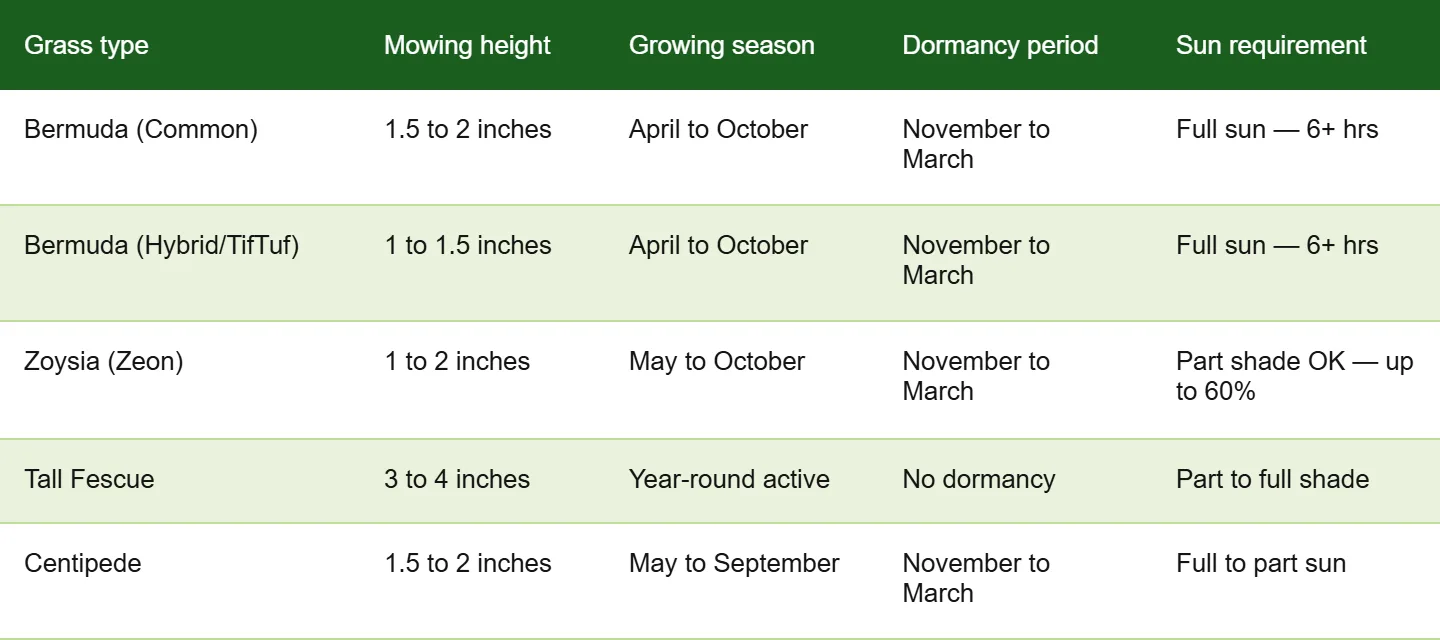
The grass type on your property determines everything: when to mow, how short to cut, when to fertilize, when to handle dormancy, and what cleanup work is needed each season. North Georgia’s three-county service area supports four primary grass types, and getting the right information for your specific variety is the most important foundation of good lawn care.
One additional note on mowing equipment: dull mower blades tear grass rather than cutting it cleanly. Torn grass blades are more susceptible to disease and show a ragged brown tinge across the lawn surface after mowing. Sharpen or replace mower blades at least once per season — more often if you’re mowing frequently or hitting debris. A sharp blade makes a measurable difference in the finished appearance and health of the lawn.
Bermuda is the most common grass type across Dawsonville’s HOA communities and the warm-season standard across Forsyth County’s newer subdivisions. It’s heat-tolerant, traffic-durable, and grows aggressively during peak season — which is both its strength and the source of most maintenance challenges. During the growing season, Bermuda in Dawsonville’s climate grows fast enough that skipping a week creates a significantly harder mow.
Common Bermuda (the variety in most established Dawsonville lawns) should be mowed at 1.5 to 2 inches. Hybrid Bermuda varieties like TifTuf and Tifway 419, increasingly common in newer Forsyth County installations, perform best at 1 to 1.5 inches. The critical rule for both is the one-third rule: never remove more than one-third of the blade height in a single mowing. Violating this rule — cutting too much at once — stresses the grass, weakens the root system, and opens the door for weeds.
Zeon Zoysia is the most widely recommended grass for Dawsonville’s wooded properties, and for good reason. It tolerates up to 60% shade from the mature White Oak, Hickory, and Tulip Poplar canopy that characterizes Dawson County’s older residential lots — conditions where Bermuda would thin out within two to three seasons. Zoysia also requires significantly less water than Bermuda once established and naturally suppresses weeds through density alone.
The trade-off with Zoysia is establishment time and cost. It roots more slowly than Bermuda (expect 6 to 10 weeks for full establishment after sod installation in North Georgia) and costs more per pallet. But for a Dawsonville property with significant shade, Zoysia is the only warm-season option that consistently delivers.
Tall Fescue is a cool-season grass that stays green year-round in Dawsonville’s Zone 7b climate — the primary reason it’s chosen for properties where the Bermuda dormancy period (brown lawn from November to March) is not acceptable. It’s the right answer for heavily shaded properties where Zoysia also struggles, particularly on north-facing slopes and creek-side lots where the canopy is dense and consistent.
The key limitation is that Fescue cannot be installed or seeded during summer heat — it requires cool soil temperatures to establish. Fall installation (September through November) is essential. A Fescue lawn installed in Dawsonville’s summer heat will fail. It also requires overseeding each fall as it thins through the summer heat stress period, which is a maintenance requirement Bermuda and Zoysia do not have.
Tall Fescue is a cool-season grass that stays green year-round in Dawsonville’s Zone 7b climate — the primary reason it’s chosen for properties where the Bermuda dormancy period (brown lawn from November to March) is not acceptable. It’s the right answer for heavily shaded properties where Zoysia also struggles, particularly on north-facing slopes and creek-side lots where the canopy is dense and consistent.
The key limitation is that Fescue cannot be installed or seeded during summer heat — it requires cool soil temperatures to establish. Fall installation (September through November) is essential. A Fescue lawn installed in Dawsonville’s summer heat will fail. It also requires overseeding each fall as it thins through the summer heat stress period, which is a maintenance requirement Bermuda and Zoysia do not have.
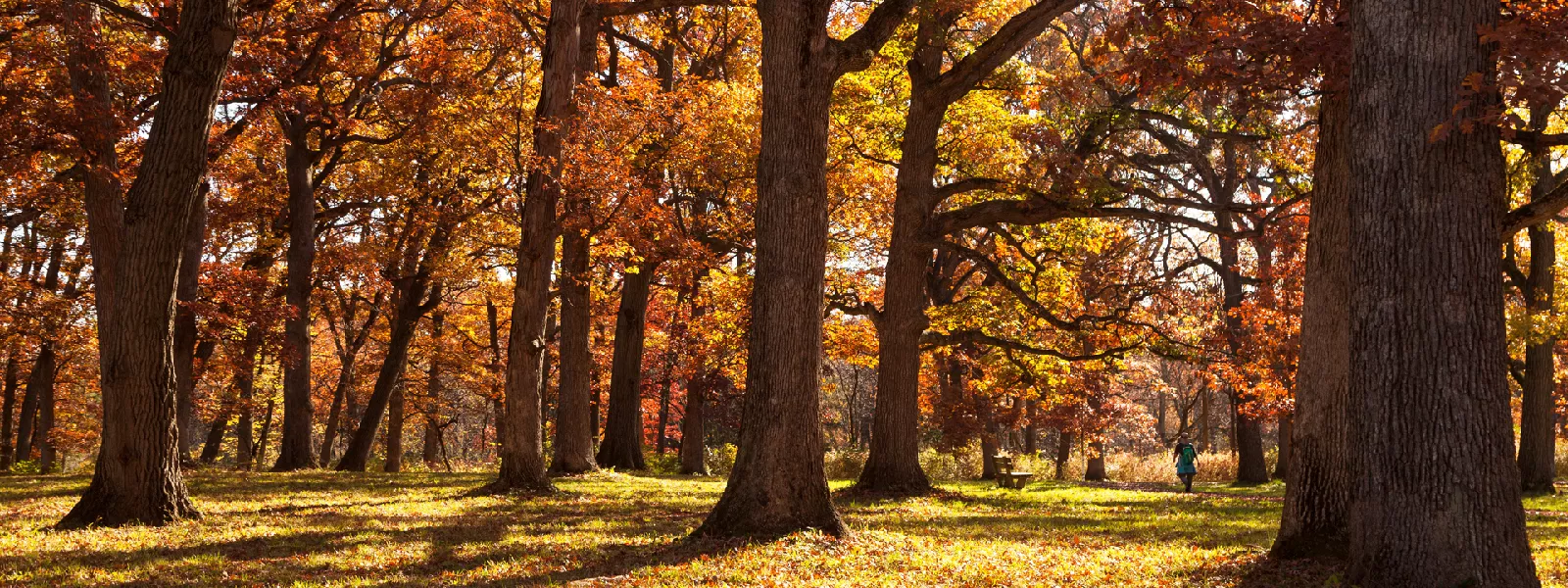
Seasonal cleanup is not optional maintenance in Dawsonville. The wooded character of Dawson County, with its mature White Oak, Hickory, Tulip Poplar, and Maple canopy, means that fall leaf accumulation is a genuine lawn health issue — not just an appearance problem. Understanding what each cleanup accomplishes and when to do it is as important as getting the work done.
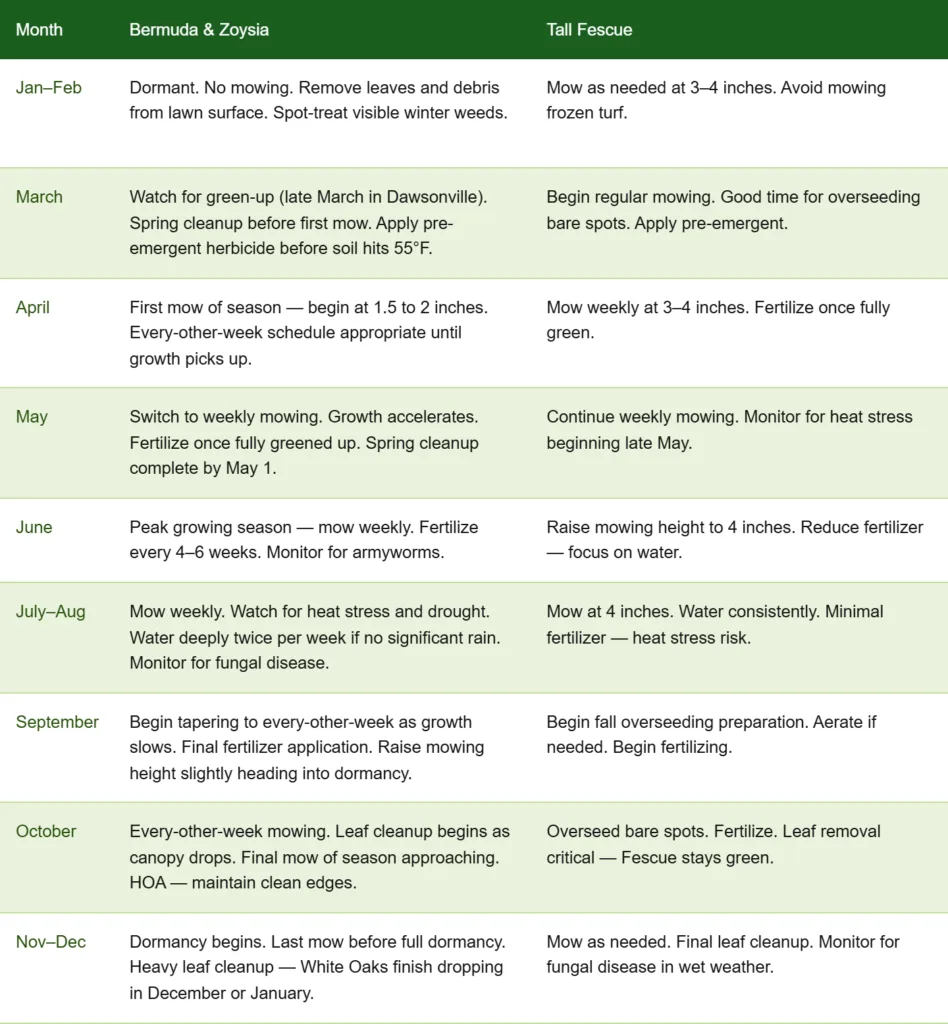
For Bermuda and Zoysia lawns in Dawsonville, January and February are the true dormant months. The grass is brown, growth has stopped, and the temptation is to ignore the lawn entirely. That’s mostly the right instinct — but a few things matter during this window.
The most important task is keeping leaves and debris off the dormant lawn surface. A mat of wet leaves sitting on dormant Bermuda or Zoysia from November through February holds moisture against the turf crown, blocks the limited light the dormant grass still needs, and creates the warm, damp conditions that fungal pathogens like Large Patch and Brown Patch need to establish. You will see that fungal damage in April when the lawn greens up — often as irregular brown patches in areas that looked fine going into fall.
For Tall Fescue homeowners, January and February still require occasional mowing when the grass is actively growing. Avoid mowing frozen turf, but otherwise Fescue lawns in Dawsonville’s Zone 7b climate stay green enough through winter that complete neglect is not an option.
March is the most critical month on the Dawsonville lawn care calendar, and the one where timing mistakes cause problems that last through the entire growing season. Two things have to happen in March in the right order: spring cleanup must be complete before the first mow, and pre-emergent herbicide must be applied before soil temperatures reach 55 degrees Fahrenheit.
For Bermuda and Zoysia lawns, watch for green-up signals — the lawn shifts from full brown to a hint of green at the soil surface, starting from low-lying areas and south-facing exposures. In Dawsonville, this typically happens in late March, though it can be as late as early April on properties with heavy shade or north-facing terrain. Do not mow until the lawn shows visible green growth — scalping a lawn before green-up stresses the grass without the recovery benefit of an already-active growing cycle.
Pre-emergent herbicide application timing is where most homeowners miss the window. Crabgrass seeds germinate when soil temperatures hit 55°F — in North Georgia, that’s typically late February to mid-March depending on the year. Apply pre-emergent before that threshold, not after. Once crabgrass has germinated, pre-emergent is ineffective, and you’re dealing with a much harder problem all season.
Pro Tip
Check soil temperature rather than calendar date for pre-emergent timing. A soil thermometer from any garden center costs under $15 and tells you exactly when to apply. In Dawsonville, check the soil temperature at a 4-inch depth starting in late February. Apply pre-emergent when you hit 50-53°F — you have a short window before the seeds activate.
April is when the mowing season begins for most Dawsonville Bermuda and Zoysia lawns. By the time your lawn has visibly greened up and started active growth, it’s time to establish your mowing schedule and height for the season. Start at your grass type’s recommended height — 1.5 to 2 inches for common Bermuda, 1 to 2 inches for Zoysia — and resist the urge to cut shorter to delay the next mow. Cutting too short weakens the root system and invites weeds.
Every-other-week mowing is usually sufficient through most of April as growth is still ramping up. By early to mid-May, most Dawsonville Bermuda lawns are growing fast enough to require weekly service to stay at a manageable height without removing more than one-third of the blade in a single cut.
May and June represent the most demanding stretch of the Dawsonville lawn care calendar. Bermuda and Zoysia are growing at peak rate — in some weeks, skipping a mow means the next visit requires cutting significantly more than the one-third rule allows, which results in a stressed, scalped-looking lawn rather than the clean, finished appearance most HOA homeowners need.
Weekly mowing is not optional for most Bermuda lawns during May through mid-September in Dawsonville’s climate. It’s the schedule that keeps the grass at the correct height, prevents thatch buildup, and maintains the dense, tight canopy that naturally suppresses weeds. Homeowners who try to get by with every-other-week service during peak growth consistently report that their lawns look worse and require more remedial work over time.
May is also the right window for your first fertilizer application on Bermuda and Zoysia once the lawn is fully greened up. Apply fertilizer when the grass is actively growing and can use it — applying too early, while the lawn is still partially dormant, wastes product and can stress the grass.
Pro Tip
Armyworms are the most damaging summer pest in North Georgia and can destroy a Bermuda lawn in days. Watch for patches of grass that appear to be rapidly scalping from the outside in — armyworm damage looks like someone mowed irregular patches overnight. Treat immediately with a labeled insecticide if you see the damage. Check for armyworms by parting the grass near the edge of damage and looking for green caterpillars with striped markings.
July and August in Dawsonville bring a heat-and-humidity combination that tests every warm-season lawn. Bermuda handles heat well, but Zoysia and Fescue lawns need more careful management during this window. For all grass types, the most common mistake is watering too frequently and too shallowly — daily light watering produces shallow root systems that struggle during dry periods.
The right watering approach for Bermuda and Zoysia during summer heat is deep, infrequent irrigation — one to two deep waterings per week that soak to 4 to 6 inches of soil depth, rather than daily light surface watering. Deep watering pushes roots deeper into the soil profile, which is where they need to be to survive Dawsonville’s periodic summer dry spells. Watch for drought-stress signals: a blue-grey tinge to the grass blades or footprints that remain visible after walking across the lawn. For more on efficient lawn watering, the EPA’s WaterSense program is a helpful resource.
For Tall Fescue homeowners, July and August are the highest-stress months of the year. Raise the mowing height to 4 inches — the additional blade height provides shade for the soil surface, reduces evaporation, and helps the grass survive the heat. Avoid fertilizing Fescue during the heat of summer; the nitrogen stimulates growth at exactly the wrong time.
September is the transition month. For Bermuda and Zoysia lawns, growth slows noticeably as day length shortens and temperatures cool. This is the time to begin tapering mowing frequency from weekly to every-other-week, raise the mowing height slightly to protect the crown going into dormancy, and apply a final fertilizer if timing and soil temperature are right — typically before mid-September in Dawsonville.
October is when leaf management becomes the dominant lawn care task for most Dawsonville properties. Early-dropping species — Maple, Tulip Poplar, some Oaks — begin dropping in October. On properties with significant canopy, the first leaves hit the ground before the Bermuda lawn has fully gone dormant, which means active turf is being covered at exactly the wrong time. Keeping up with leaf removal in October protects the lawn through the transition period.
By November, most Bermuda and Zoysia lawns in Dawsonville are fully dormant or approaching dormancy. The last mow of the season typically falls in late October or early November — let the grass tell you when, not the calendar. When active growth has genuinely stopped, the final mow is done.
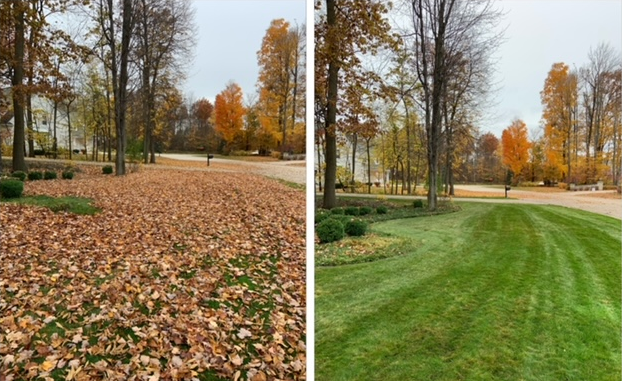
December is the most important month for leaf cleanup on Dawsonville’s wooded properties. White Oak — the dominant large hardwood on many older Dawson County lots — is one of the latest-dropping trees in North Georgia, often completing its drop in December or even early January. A single fall cleanup in October or November leaves the biggest part of the leaf load still on the lawn. On heavily wooded properties, a two-visit fall cleanup program — an initial visit in November and a follow-up in December or January — is the only approach that actually clears the lawn before spring green-up.
Pro Tip
Check soil temperature rather than calendar date for pre-emergent timing. A soil thermometer from any garden center costs under $15 and tells you exactly when to apply. In Dawsonville, check the soil temperature at a 4-inch depth starting in late February. Apply pre-emergent when you hit 50-53°F — you have a short window before the seeds activate.
Mowing is the foundation of lawn health in North Georgia. Done correctly, it keeps the grass at a height that promotes healthy root development, suppresses weeds through canopy density, and maintains the finished appearance that HOA communities require. Done incorrectly — cutting too short, mowing too infrequently, or using dull blades — it’s one of the fastest ways to damage a lawn that might otherwise look great.
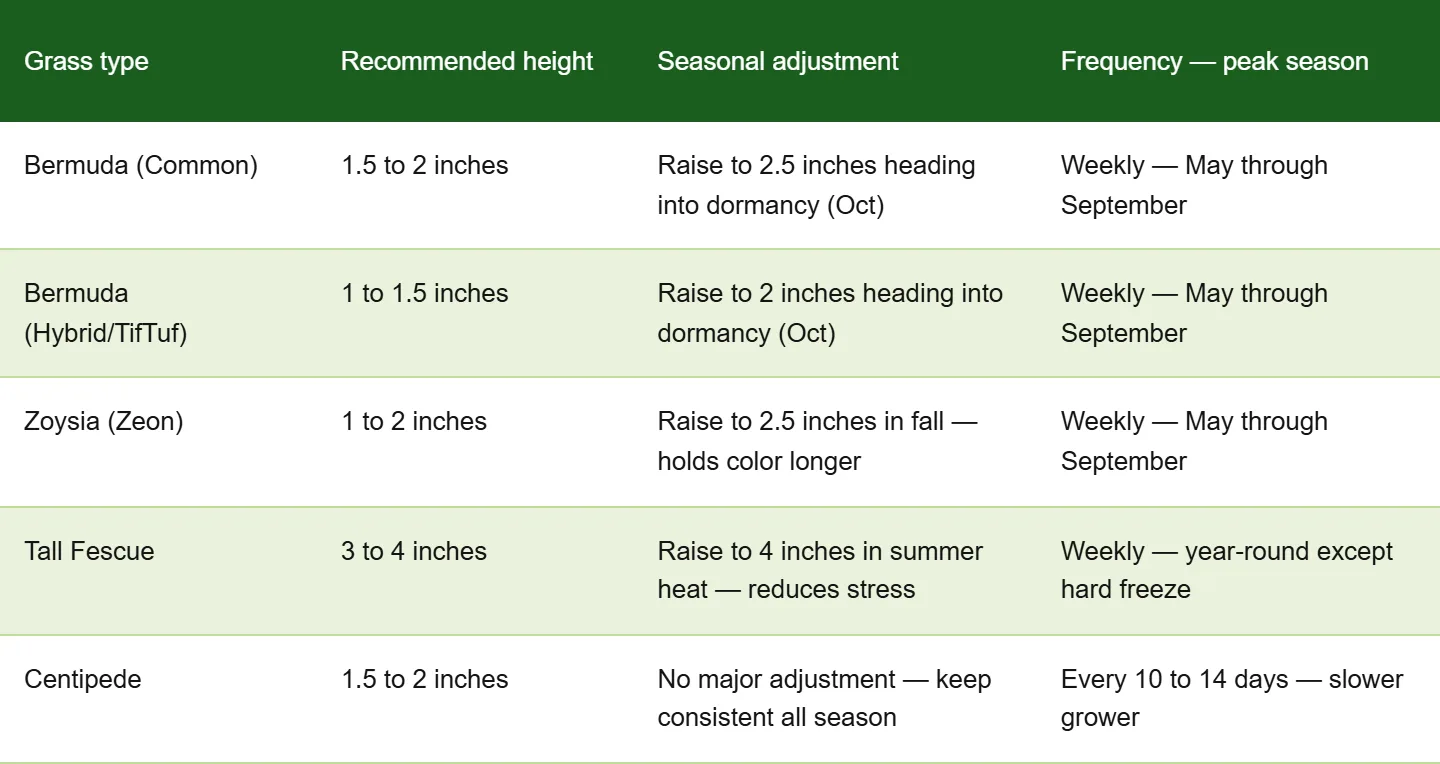
The correct mowing schedule depends on your grass type and the time of year, not personal convenience. During Bermuda’s active growing season in Dawsonville — roughly May through mid-September — weekly mowing is not a preference, it’s what the growth rate requires. A Bermuda lawn growing at peak rate in June will put on 2 to 3 inches of new growth in a week. Cutting that back to a proper height requires removing close to the one-third limit in a single pass. Waiting two weeks means the next mow either violates the one-third rule or leaves the lawn too tall for the following week.
Every-other-week mowing is appropriate for Bermuda and Zoysia during dormancy ramp-up (March and April), the fall transition period (October), and through the dormant season for Fescue. It’s the right schedule when the growth rate genuinely supports it — not as a cost-saving measure during peak growth season.
For full pricing, scheduling details, and everything included on every mowing visit, see our Lawn Mowing service page.
Cutting grass too short is one of the most common and damaging mistakes in lawn care. Scalping the lawn — removing too much blade height in a single cut — exposes the turf crown, stresses the root system, and creates an opening for weeds to establish in the thin, weakened turf. The correct mowing height for your grass type is not arbitrary — it’s the height at which the grass can photosynthesize effectively and maintain the root depth needed for drought tolerance and disease resistance.
One additional note on mowing equipment: dull mower blades tear grass rather than cutting it cleanly. Torn grass blades are more susceptible to disease and show a ragged brown tinge across the lawn surface after mowing. Sharpen or replace mower blades at least once per season — more often if you’re mowing frequently or hitting debris. A sharp blade makes a measurable difference in the finished appearance and health of the lawn.
Seasonal cleanup is not optional maintenance in Dawsonville. The wooded character of Dawson County, with its mature White Oak, Hickory, Tulip Poplar, and Maple canopy, means that fall leaf accumulation is a genuine lawn health issue — not just an appearance problem. Understanding what each cleanup accomplishes and when to do it is as important as getting the work done.
Seasonal cleanup is not optional maintenance in Dawsonville. The wooded character of Dawson County, with its mature White Oak, Hickory, Tulip Poplar, and Maple canopy, means that fall leaf accumulation is a genuine lawn health issue — not just an appearance problem. Understanding what each cleanup accomplishes and when to do it is as important as getting the work done.
Spring cleanup in Dawsonville means removing what winter left behind before the first mow of the season opens the growing window. That includes the final wave of late-dropping White Oak leaves that fell in January, any storm debris from winter ice and wind events, dead growth in beds that needs clearing, and the matted layer of organic material that has packed down against the soil surface through months of wet weather.
Getting spring cleanup done before the first mow matters for one practical reason: mowing over heavy debris — particularly thick leaf mat — spreads material across the lawn, clogs mowing equipment, and leaves an uneven surface that looks neglected even after a fresh cut. A clean lawn going into the first mow of the season gives the growing season the best possible start.
For Bermuda and Zoysia lawns especially, clearing debris before green-up removes the organic layer that can host fungal disease and slow the warming of the soil surface — both of which delay and weaken spring green-up.
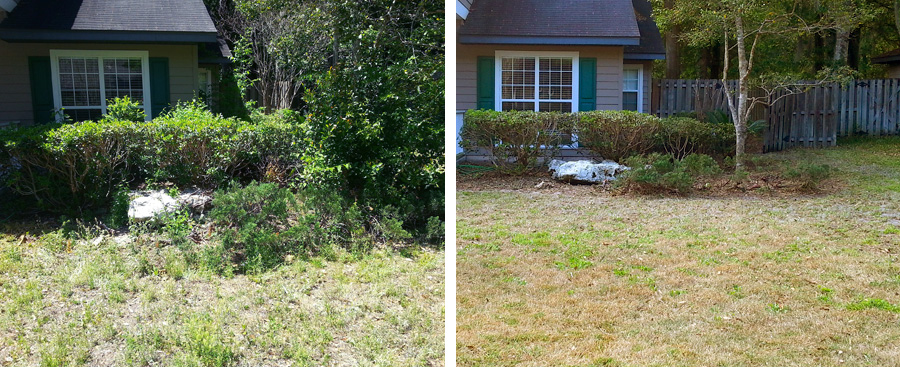
For full details on our spring and fall cleanup service, what’s included, and scheduling for Dawsonville and Dawson County, see our Spring & Fall Cleanup page.
Fall cleanup in Dawson County is more complicated than in most markets because of White Oak. White Oak is one of the latest-dropping deciduous trees in North Georgia — on many Dawsonville properties with mature canopy, White Oaks don’t finish dropping until late December or January. Properties with significant White Oak coverage need a two-visit fall cleanup approach: an initial visit in November to clear the early-dropping species, and a follow-up visit in December or January after the Oaks finish.
A single October cleanup misses the biggest part of the leaf load on any property with White Oak in the canopy. The practical consequence is a wet leaf mat sitting on dormant Bermuda or Zoysia from November through spring — exactly the conditions that produce the fungal damage and uneven green-up that frustrate homeowners every April.
For properties needing dedicated leaf removal — multiple visits, wooded acreage, or standalone leaf cleanup without a full seasonal reset — see our Leaf Cleanup service page.
A healthy lawn doesn’t exist in isolation. The landscaping around it — the beds, the edging, the mulch, the plants and trees — directly affects how your lawn looks, how it performs, and how much maintenance it requires. Getting the landscaping side right reduces the ongoing effort of keeping the lawn looking its best.
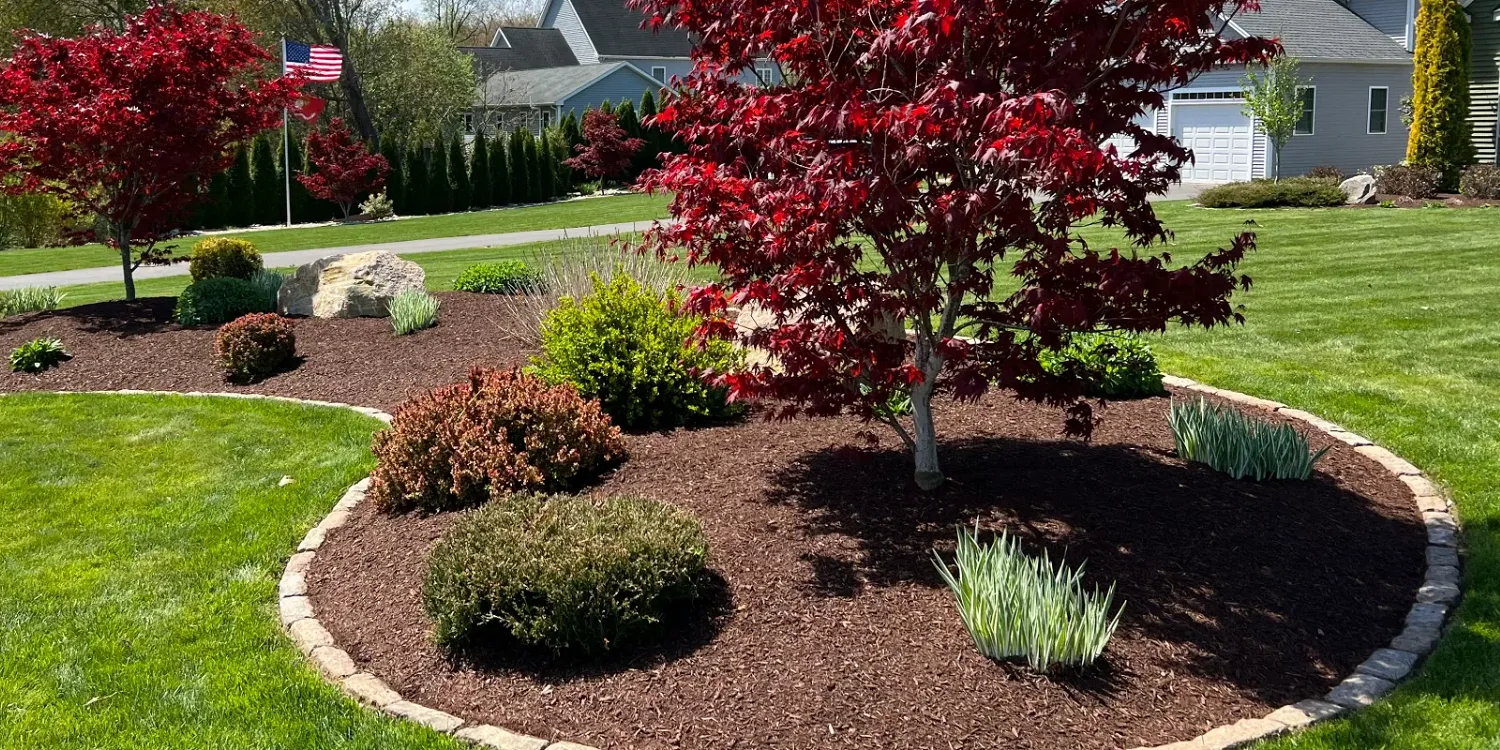
Fresh mulch or pine straw in your garden beds does more than make the property look finished. A properly maintained 2 to 3-inch mulch layer suppresses weeds that would otherwise migrate into the adjacent lawn edge, retains moisture during Dawsonville’s summer dry spells, and protects plant roots through Zone 7b winter cold snaps. Beds that are refreshed annually with longleaf pine straw or quality softwood mulch require significantly less remedial weeding — which is time and money saved across the growing season.
For Dawsonville’s wooded properties and sloped beds, longleaf pine straw is consistently the better choice over standard mulch. The long, interlocking needles grip the soil surface and each other in a way that holds on grades where wood mulch washes downhill in a summer storm. Longleaf also holds its color for 9 to 12 months — making it a genuinely annual product rather than something that needs refreshing every six months.
For full details on mulch and pine straw materials, pricing, and installation, see our Mulch & Pine Straw Installation page.
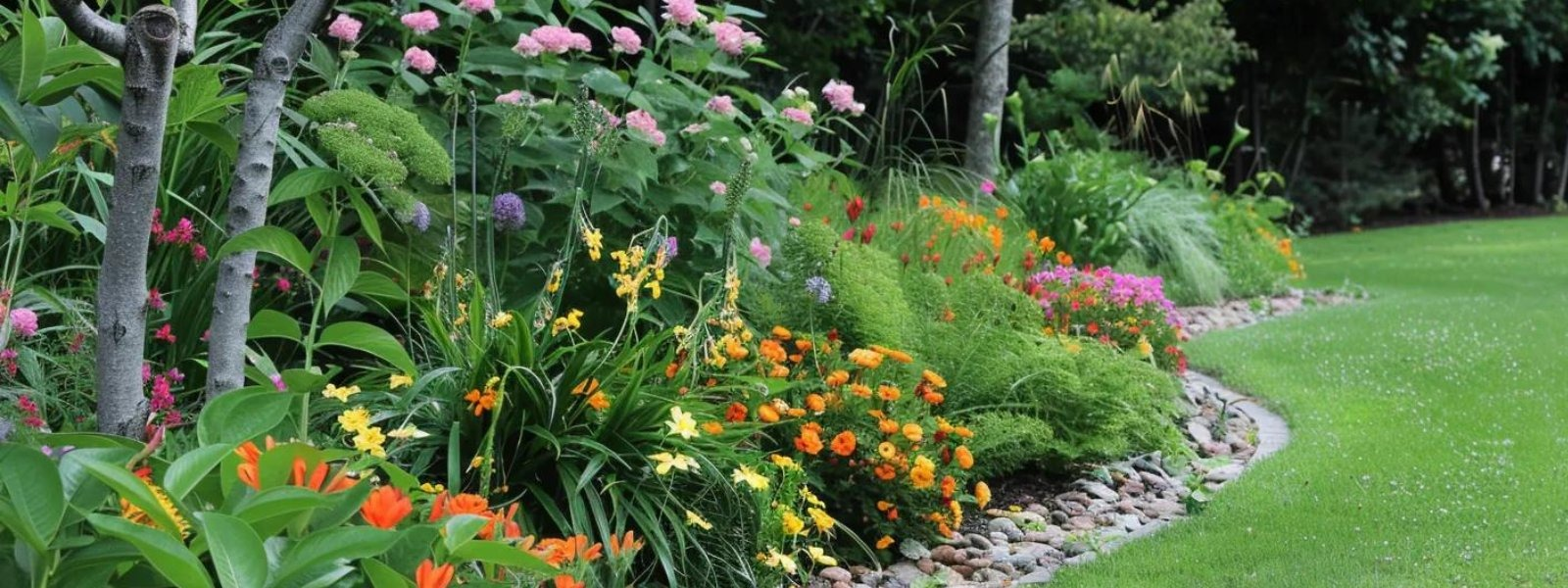
A defined physical border between your lawn and your beds does two things: it makes the entire property look intentional and maintained, and it stops grass roots from creeping into the bed. Bermuda grass — the most common lawn type in Dawsonville — is one of the most aggressive spreaders in warm-season grasses. Without a physical edging barrier, Bermuda stolons creep into beds, around tree rings, and along walkways in a single season, undoing months of bed maintenance.
Metal edging is the most popular choice on Dawsonville’s HOA properties — it creates a permanent, low-profile rail that holds its line for 10 to 20 years and requires no ongoing maintenance beyond occasional re-staking after a hard freeze. Stone and brick edging is common on older Dawsonville properties and wooded lots where the naturalistic aesthetic fits the surrounding landscape.
For edging material options, pricing, and the installation process, see our Garden Bed Edging Installation page.
The plants and trees on your property affect your lawn more than most homeowners realize. Overgrown shrubs cast unwanted shade on Bermuda lawns that need full sun. Trees installed too close to the lawn create root competition that steals water and nutrients from the turf. Poorly sited plantings in heavy-shade areas create dead patches that no amount of mowing or fertilizing can fix.
Plant and tree installation done right — with a site assessment, correct species selection for your specific sun and soil conditions, and proper soil preparation — eliminates most of these downstream problems before they start. For Dawsonville’s deer-pressure properties, plant selection also has to account for the browse risk, which eliminates many standard landscape choices entirely.
For plant and tree selection specific to Dawsonville’s wooded lots, shade conditions, and deer pressure, see our Plant Installation page.
The Dawsonville lawn care market includes a wide range of operators — from established local companies to regional service apps that dispatch whoever is available in your ZIP code. Getting the right fit matters, particularly for HOA properties where consistency and reliability are not optional.
These are the qualities that separate a lawn care company worth hiring from one that will create more problems than they solve:
For Bermuda and Zoysia lawns in Dawsonville, the active lawn care season begins in late March to early April — about one to two weeks later than Metro Atlanta. Watch for visible green-up at the soil surface before mowing, and apply pre-emergent herbicide before soil temperatures hit 55°F, typically late February to mid-March in Dawson County. For Tall Fescue lawns, care is year-round since Fescue stays actively growing through North Georgia's winter.
It depends on your sun exposure, soil conditions, and maintenance preferences. Bermuda is the most common choice for full-sun HOA properties in Dawsonville, Gainesville, and Cumming — it's heat-tolerant, durable, and establishes reliably. Zeon Zoysia is the best warm-season option for properties with significant shade from mature hardwood canopy. Tall Fescue is the right answer for properties where dense shade makes warm-season grasses impractical, or for homeowners who can't tolerate the Bermuda dormancy period from November through March. Centipede is the lowest-maintenance warm-season option and works naturally with North Georgia's acidic red clay.
Bermuda grass in Dawsonville typically begins going dormant in October as days shorten and temperatures drop, and reaches full dormancy by mid to late November. The last mow of the season for most Dawsonville Bermuda lawns falls in late October or early November. Dormancy lasts through winter until late March to early April when soil temperatures warm enough to trigger green-up. The exact timing varies by property — properties with full south-facing sun exposure go dormant later and green up earlier than shaded or north-facing properties.
Red clay is challenging but workable. Its primary problems are poor drainage in low spots, compaction under traffic, and an acidic pH (5.0 to 5.5) that falls below what Bermuda and Zoysia prefer. With proper soil amendment — breaking up compaction, adding compost to improve drainage and organic content, and adjusting pH — North Georgia red clay can support healthy warm-season lawns. Centipede grass is the exception — it actually thrives in the native acidic clay without amendment, which is why it's worth considering for properties where amendment cost is a concern.
For Bermuda lawns in Dawsonville, weekly mowing is the correct schedule from May through mid-September. Bermuda grows fast enough during this period that a two-week interval results in removing more than the recommended one-third of the blade height in a single mow, which stresses the grass and weakens the root system. Zoysia follows a similar schedule, though it grows slightly slower. Fescue in summer heat benefits from every-other-week mowing at a higher cut height of 4 inches to reduce heat stress.
Apply pre-emergent in late February to mid-March, before soil temperatures reach 55°F at a 4-inch depth. This is the critical window for preventing crabgrass and other summer annual weeds. In Dawsonville's Zone 7b climate, this typically means late February to the first two weeks of March depending on the year. A soil thermometer is the most reliable tool — calendar date alone is not precise enough given year-to-year variation in spring warming patterns across Dawson County.
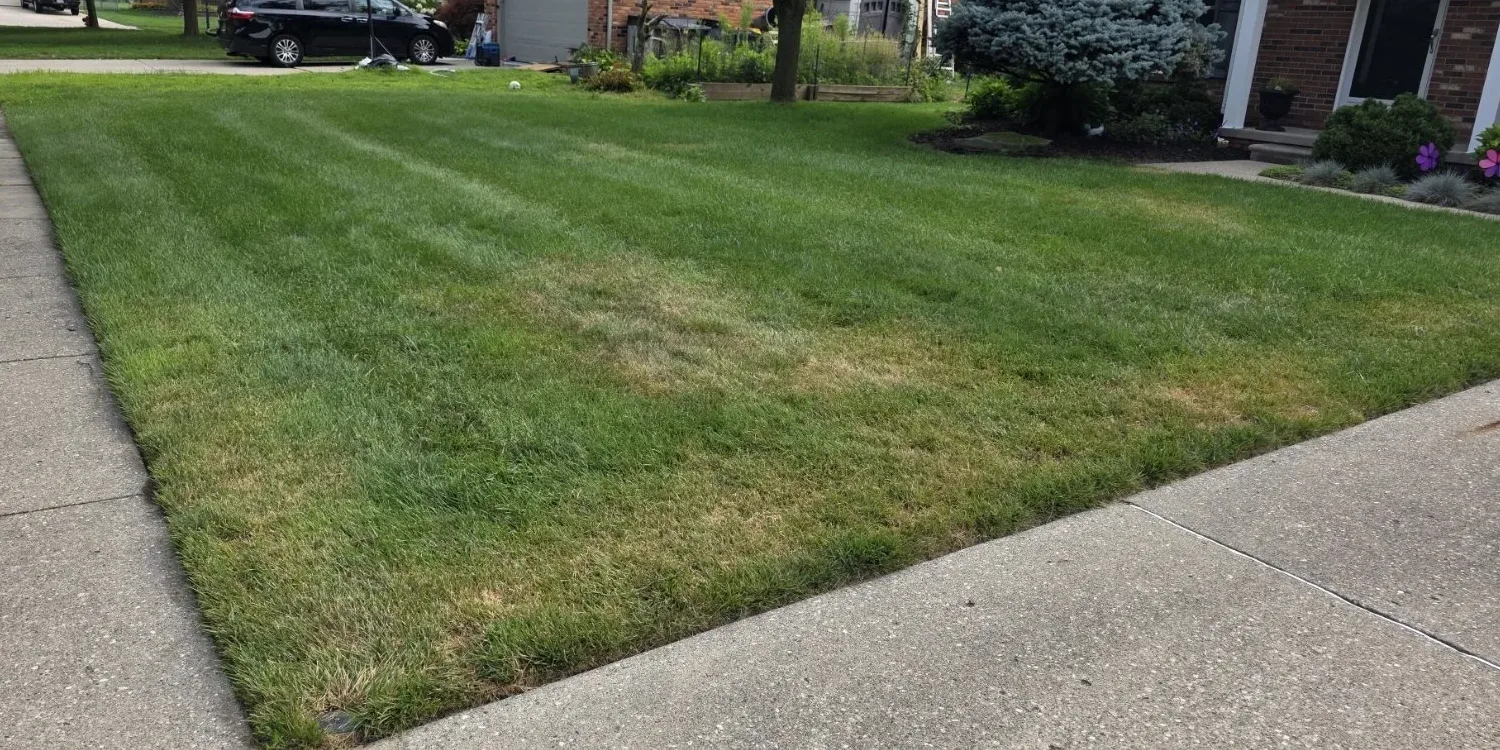
Brown patches appearing in a Bermuda or Zoysia lawn during spring green-up are most commonly caused by one of two things: fungal disease established under a leaf mat during winter dormancy, or areas where the lawn was cut too short going into dormancy. Large Patch and Brown Patch fungal diseases are common in North Georgia and develop when wet leaves sit on dormant turf through winter, holding moisture against the crown. The best prevention is thorough fall leaf removal before the leaf mat becomes established. If brown patches appear in spring, a licensed lawn care professional can assess whether the cause is fungal or mechanical and recommend appropriate treatment.
They serve different purposes. Spring and fall cleanup is a full property reset — clearing debris, dead growth, matted bed material, and storm leftovers from the entire yard. Leaf removal is a standalone service focused specifically on clearing leaf accumulation from the lawn and beds, typically through multiple visits during the fall drop season. Many Dawsonville homeowners with heavily wooded properties need both: a seasonal cleanup for the full property reset, and dedicated leaf removal visits from October through January to stay ahead of the White Oak and Hickory canopy. Properties with less tree canopy can often manage with cleanup only.
Monday – Friday:
8:00 am to 5:00 pm
Saturday & Sunday:
Closed
Copyright 2026 © All Rights Reserved.