
Gainesville's Sod Installation Specialists
Home / Sod Installation Gainesville Ga
Gainesville Yards Are Different. The Terrain Demands More Than a Standard Sod Install.
Gainesville isn’t a flat suburb. Hall County’s rolling hills, ridge-top properties, and lake-adjacent lots create landscaping challenges that don’t exist in most of North Metro Atlanta — and seed is particularly poorly suited to them. On a sloped Gainesville yard, the first hard rain after seeding moves everything. The topsoil goes, the seed goes, and you’re left with exposed red clay channels and a bare slope that looks worse than when you started.
Sod changes that calculation entirely. A properly installed sod lawn creates an immediate root mat that anchors your soil, stops surface erosion, and gives your Hall County property a finished appearance from the day we leave. Dawsonville Lawn Pros has been installing sod in Gainesville and across Hall County for 11 years. We’ve worked on flat lakefront lots off Thompson Bridge Road, steep ridge-top properties in the Mundy Mill corridor, and everything in between. The terrain here is our expertise — not a complication.
Why Gainesville's Terrain Makes Sod the Smart Choice Over Seed
Hall County’s geography — ridgelines, creek valleys, and the sloping terrain that runs toward Lake Lanier — creates specific conditions that make sod the clearly superior choice for most Gainesville homeowners. Here’s how the comparison breaks down on the terrain types we see every day across this county.
Other Services
Maintenance
Landscaping
Sod Installation Downloads
The Lake Lanier Proximity Factor
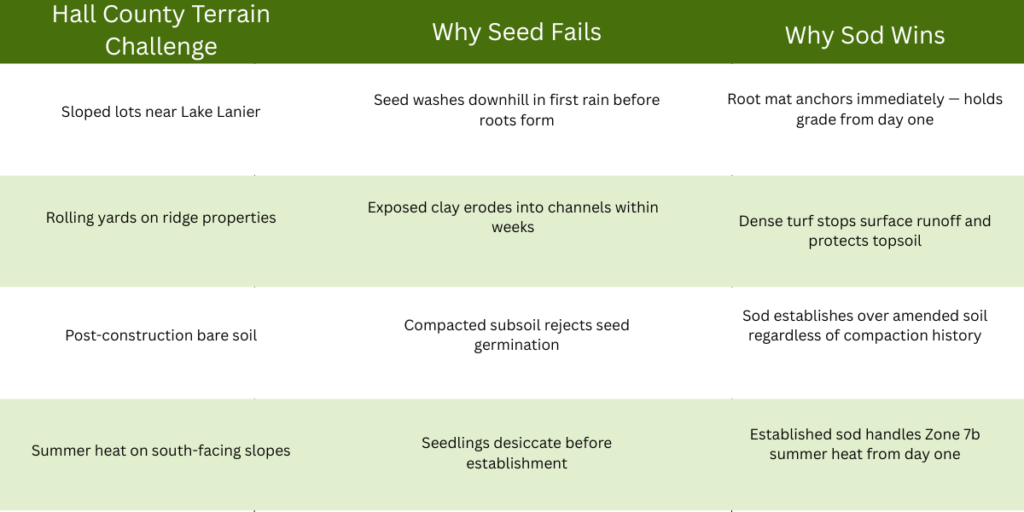
Properties in Gainesville’s Lake Lanier corridor face a specific erosion risk that inland properties don’t share. Seasonal lake fluctuations, boat wake erosion on waterfront banks, and the natural drainage flow of shoreline terrain all create conditions where bare soil loss happens quickly. Sod installed on a sloped lakefront property doesn’t just look better — it actively protects your bank, your grade, and in some cases your dock access from ongoing erosion. For any Gainesville property within a few blocks of Lake Lanier, we treat erosion control as the primary installation objective, not a secondary benefit.
Hall County soil note: Gainesville’s red clay runs acidic (pH 5.0–5.5) and compacts heavily after rain events on sloped terrain. We address compaction, pH, and drainage grade at every installation — these aren’t optional steps on Gainesville’s terrain, they’re what makes the difference between sod that roots in three weeks and sod that fails in three months.
Sloped Yard? Lakefront Property?
We've Installed Both.
Free site visits for Gainesville and all of Hall County. We bring the expertise — you just show us the terrain.
How We Install Sod in Gainesville — Slope-Aware, Soil-First
Every sod installation in Gainesville gets approached through the lens of Hall County’s terrain — the slope gradients, the clay composition, the drainage patterns, and the proximity to Lake Lanier where applicable. This is what our process looks like on a Gainesville property.
1
Terrain & Drainage Assessment
Before we quote a project in Gainesville, we walk the property and read its topography. We’re tracking where water moves during a rain event, where it pools, where it accelerates down a grade, and where existing erosion channels have already formed. On lakefront or near-shore Hall County properties, we factor in the additional drainage load from adjacent terrain. This assessment determines not just what soil prep is needed, but how we grade and orient the sod installation to work with your property’s natural water movement rather than against it.
2
Slope-Appropriate Vegetation Removal
On flat Gainesville lots, existing vegetation comes out the standard way. On sloped properties, we’re methodical about the sequence — removing material top to bottom to prevent disturbed soil from traveling downhill before the new sod goes in. We don’t leave bare, disturbed slope exposed overnight on any Hall County project where rain risk is present. The installation window is planned around the weather forecast.
3
Drainage Grading with Slope Consideration
On flat Gainesville properties, grading establishes positive drainage away from the foundation — standard practice. On sloped properties, grading is more nuanced: we’re managing the velocity of water running downhill, creating gentle grade breaks where needed, and ensuring that water drains off the sod surface rather than undercutting the root mat from underneath. On lakefront lots, we establish drainage that directs runoff away from the bank and the waterline.
4
Hall County Clay Correction
Gainesville’s red clay has a pH of 5.0–5.5 and compacts aggressively on sloped terrain after rain events, especially where builder or construction traffic has compacted the soil. For Bermuda and Zoysia installs, we break up compaction, amend with high-quality compost or topsoil, and adjust pH toward the 6.0–6.5 range preferred by those varieties. For Centipede, we assess whether your native clay is already within the right range and often skip pH amendments entirely — saving you money while producing equal or better results.
5
Staked Installation on Slopes
On Gainesville’s steeper grades, we stake sod rolls with biodegradable stakes to prevent slippage during the establishment window — a step many installers skip to save time that costs the homeowner a failed installation. On flat properties, standard laying and rolling produces full soil contact. On any grade where slippage is a risk, stakes go in as standard practice, not an upsell.
6
First Soak, Slope-Specific Watering Instructions
Watering newly installed sod on a slope requires different technique than watering a flat yard — too much water too fast creates runoff that lifts sod edges and pools at the base rather than soaking in. Your written aftercare guide from Dawsonville Lawn Pros includes slope-specific watering intervals and duration recommendations for your particular install, not a generic schedule that’s the same for every yard.
Sloped Installs Are Our Specialty — Get a Quote for Your Hall County Property
We’ve installed sod on Gainesville’s toughest terrain for 10+ years. Flat yards, ridge lots, lakefront banks — we’ve done them all.
The Right Grass for Your Gainesville Property
Hall County’s mix of sun-drenched ridge-top lots, shaded creek-side yards, and waterfront properties means grass selection matters more here than in most markets. The same variety that thrives on an open south-facing slope will fail under the canopy of mature White Oaks on a north-facing lot two streets away. Here’s how each variety performs across Gainesville’s terrain types.
TifTuf Bermuda
Tall Fescue
Best installed: April – September
Best for: Ridge-top and open lots, full sun
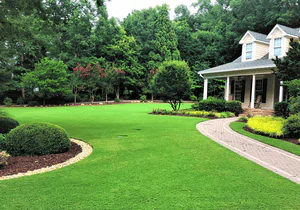
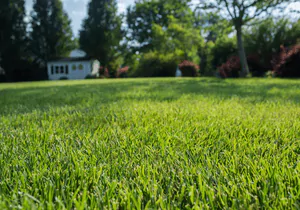
Bermuda is the right choice for Gainesville’s open, sun-exposed properties — ridge-top lots with sweeping views, lake-view front yards with minimal tree cover, and any Hall County property that gets full sun throughout the growing day. Its dense, low-growing habit makes it naturally resistant to erosion on moderate slopes, and it reliably handles Gainesville’s summer heat and drought. Tifway Bermuda is our most popular install on sloped Gainesville properties — it establishes quickly, roots deeply, and handles the grade changes that characterize this market. All Bermuda goes dormant from November through mid-March. Not suitable for any lot with more than 30% shade from established hardwoods.
Best installed: September – November
Best for: Deep shade, north-facing slopes
For Gainesville’s north-facing slopes and yards sitting under dense hardwood canopy where even Zoysia struggles to fill in, Tall Fescue is the dependable answer. It stays green year-round in Hall County’s Zone 7b climate — a major advantage for homeowners who don’t want the brown dormancy period that Bermuda and Zoysia deliver from November through March. Fall installation is non-negotiable for Fescue — it needs cool soil temperatures to establish its root system. A Fescue install in Gainesville’s summer heat will fail before it starts. If your property is on the shaded, north-facing side of a Hall County ridge, Fescue is the only warm-season option that genuinely delivers.
Zoysia Sod (Zeon / Zenith)
Centipede
Best installed: May – August
Best for: Shaded and wooded Hall County lots
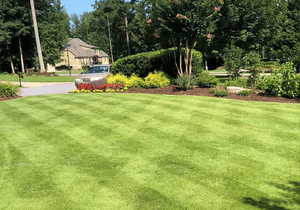
Gainesville’s wooded corridors — particularly in areas with mature White Oak and Hickory canopy common to Hall County’s older neighborhoods — are Zoysia territory. Zeon Zoysia tolerates up to 60% shade and produces a dense, fine-textured finish that holds its color longer into the fall than Bermuda. For Gainesville homeowners who want a premium-looking lawn on a lot that Bermuda can’t handle, Zeon is consistently our recommendation. Zenith Zoysia is a reliable choice for transitional shade yards where sun patterns shift seasonally, and one grass type struggles at certain times of year. Both varieties establish more slowly than Bermuda (expect 6–10 weeks in Hall County’s climate) but require significantly less maintenance once rooted.
Best installed: May – July
Best for: Hall County clay, ultra-low maintenance
Centipede is the least-discussed but often best-suited option for Gainesville homeowners who want a clean, low-input lawn on Hall County’s naturally acidic red clay soil. While Bermuda and Zoysia prefer a pH range of 6.0–6.5, your native clay can provide a pH within that range, which they prefer. Centipede actually thrives at the lower pH range — meaning less soil prep, lower install cost, and a grass that doesn’t need to be convinced to grow in your specific soil. It’s slow-growing (fewer mowing sessions), requires minimal fertilization, and performs quietly and reliably in the background. Not the right choice for high-traffic areas or visible slopes where erosion control is the priority, but an excellent fit for flat, low-visibility areas where maintenance simplicity is what matters most.
Sod Installation Pricing for Gainesville & Hall County
Pricing for sod installation in Gainesville reflects both the grass variety selected and the site conditions involved. Sloped properties or lots with significant clay correction needs will have a higher prep component than a flat residential yard — we identify and quote this transparently during your free site assessment, never as a post-installation surprise. The ranges below reflect installed pricing for standard residential projects across Hall County.
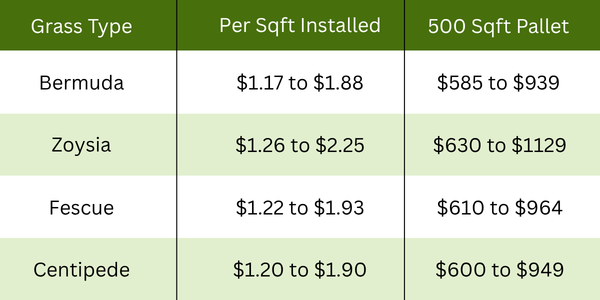
Slope and erosion note: Gainesville properties on moderate to steep grades may require staking, additional grading, or erosion-control measures during the establishment window. We itemize these separately during your free site walk. We identify every condition-specific cost upfront so your written estimate is accurate.
The low price is 6,000 sq ft, and the high price is 500 sq ft. Price may change depending on many different factors; however, this is a good range.
Terrain Affects Price — Your Free Estimate Accounts for All of It
We measure your grade, assess your soil, and give you a written breakdown for your specific Hall County property.
We have a sloped lakefront property off Thompson Bridge Road that had serious erosion issues. Dawsonville Lawn Pros staked the sod on the grade, addressed the drainage before anything went down, and the bank has held through two full rainy seasons. Best landscaping investment we've made on this property
Ridge-top lot in the Mundy Mill area — full sun, steep on one side. They recommended Tifway Bermuda for the slope and explained exactly why it was the right call for erosion control. The installation crew was fast and the lawn established exactly on the timeline they gave us.
Three previous attempts at seeding our Hall County yard failed every time. Dawsonville Lawn Pros explained why seed doesn't work on our terrain and soil combination and gave us a written sod quote the same day they walked the property. Lawn has been in for one full season and looks exactly how they described it would.
We Know Gainesville's Neighborhoods — Terrain, Soil, and All
Eleven years of sod installation in Hall County means we know how each corridor of Gainesville behaves differently — the flat lakefront lots off Thompson Bridge Road, the ridge-top properties in the Mundy Mill corridor, the older wooded neighborhoods near Memorial Park, and the creek-side yards where drainage is a year-round conversation. Here are the Gainesville-area communities we serve regularly:
Mundy Mill
Chattahoochee Estates
Thompson Bridge Road
Flowery Branch
Oakwood
Lake Lanier area
Murrayville
Sardis Road area
Don’t see your community? We serve most of Hall County. Call 706-380-2214 to confirm coverage for your specific address.
Frequently Asked Questions — Sod Installation in Gainesville, GA
It's almost always the better option on a sloped Gainesville property, not just a good one. Seed on a slope is vulnerable to washout before germination — one heavy Hall County rain event can remove every seed you've planted. Sod's established root mat anchors into the amended soil immediately and holds the grade from the day of installation. On moderate to steep slopes, we stake sod rolls with biodegradable stakes as standard practice to prevent slippage during the establishment window. If erosion or slope stability is the reason you're looking at sod, you've already made the right decision.
For open, sun-facing lakefront lots in the Gainesville area, Tifway or Tif Tuff Bermuda is our most common recommendation — it establishes quickly, handles the heat and drainage demands of a lake-adjacent site, and produces a dense root mat that protects soil from erosion during storms and seasonal water fluctuations. For shadier lakefront properties where the bank's tree canopy provides more than 40% shade, Zeon Zoysia performs better. We assess your specific lot's sun and shade pattern, the grade of your bank, and any Corps of Engineers setback requirements that affect where sod can be installed during your free site walk.
Hall County's red clay behaves similarly to the clay in Dawson and Forsyth Counties — acidic (pH 5.0–5.5), dense when compacted, and prone to surface runoff on sloped terrain. The primary difference in Gainesville is the slope factor: clay on a flat lot drains slowly but predictably. Clay on a Gainesville ridgeline or slope moves during rain events, creating erosion risk that's less of a factor on Cumming's flatter new-construction lots. We address compaction and pH before every install, and we factor slope drainage into the grading step specifically for Hall County properties, where terrain makes this more critical than in a typical suburban installation.
For warm-season grasses — Bermuda, Zoysia, and Centipede — the primary installation window in Gainesville is late April through early September, when Hall County soil temperatures are warm enough for rapid root establishment. The sweet spot is late April through early June, before peak summer heat stress, and again in August through early September as temperatures begin to ease. For Tall Fescue, the installation window is September through October — cool soil temperatures are essential for Fescue establishment, and summer installs consistently fail in Gainesville's climate. We install year-round when conditions allow, and we'll let you know directly if your requested timing would affect your specific variety's success.
Most standard residential sod installations in Gainesville are completed in a single day. Properties with significant slope work, drainage correction, or large square footage (3,000+ sq. ft.) may span two days — a prep day for soil work and grading, followed by the installation day. We confirm your project's timeline during the free estimate so you can plan around it. Fresh-cut sod is delivered and installed the same day to preserve quality — we never let sod sit on pallets overnight.
The Army Corps of Engineers manages Lake Lanier's water level, which fluctuates seasonally. This affects shoreline sod installation in two ways: first, the Corps establishes a setback line that determines how close to the water's edge sod can be installed on permitted lots. Second, during high-water periods, the bank zone that's accessible for installation may be limited. We're familiar with the standard setback requirements for Hall County's Lake Lanier shoreline properties and factor this into our site assessment. If you have a permitted dock or shoreline access area, we can work around those structures as part of the installation plan.
Yes — with the right installation protocol. Summer sod installation in Gainesville requires twice-daily watering during the establishment window (weeks one through three), attention to the timing of installation to avoid extreme heat days, and selection of a grass variety that matches the conditions. Bermuda handles Gainesville's summer heat reliably once installed. Fescue should not be installed in summer under any circumstances — it will fail. Zoysia can be installed in early summer, but it benefits from more attentive watering during the first two weeks in peak heat. We advise on timing and provide a written summer-specific watering schedule for every installation during June, July, and August.
In addition to sod installation, we provide mulch and pine straw installation, garden bed installation and edging, plant installation, and leaf cleanup services throughout Gainesville and Hall County. All of these services are available as standalone projects or as complements to a sod installation — for example, refreshing bed edging and mulch at the same time as a new lawn installation creates a cohesive finished look for your entire property. Call [Phone Number] to discuss combining services for your Gainesville project.